In short
Underwear manufacturing comes down to fabric, waistband and testing: the everyday standard is combed ring-spun cotton jersey at 160 to 200 GSM with 5 to 10% elastane, and buyers expect OEKO-TEX Standard 100 certification, product class 2 for skin contact. Custom jacquard waistband elastic, at 3,000 to 5,000 metres per design and colour, usually sets the real minimum order.
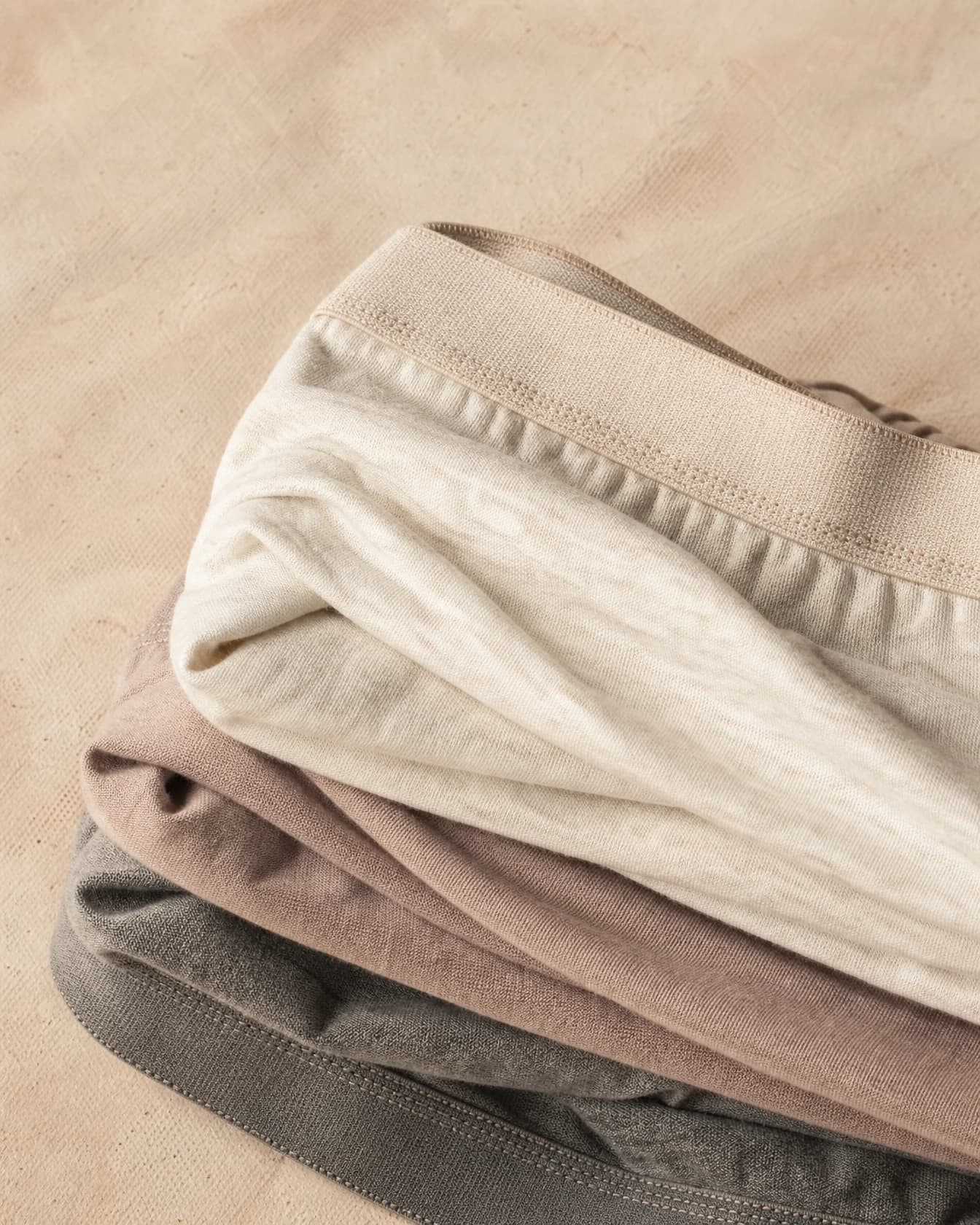
Underwear is next-to-skin product, which raises the stakes on the two things buyers often rush: fabric and fit. Neither forgives a shortcut. A tee that fits slightly wrong is still wearable; a waistband that rolls or a gusset that chafes goes straight in a drawer, and the review says why.
Here is how underwear manufacturing actually works — the fabric decisions, the construction details that decide comfort, the safety testing that is non-negotiable next to skin, and the commercial realities of MOQ and price.
Fabric: comfort is a specification, not an adjective
Combed cotton and cotton-modal for softness, microfibre for performance, with elastane for recovery — that is the map, but the details decide the product. Combed ring-spun cotton jersey at 160–200 GSM with 5–10% elastane is the everyday standard. Modal and micro-modal blends drape softer and wick better than cotton at a modest premium. Micro-polyamide (nylon) with elastane is the performance choice — smooth, quick-drying, near-invisible under clothing. Bamboo-origin viscose markets well but should be described accurately as viscose.
- Elastane content — 5% keeps shape for daily wear; performance styles run 8–15% for compression and recovery.
- Recovery matters more than stretch: fabric must return, wash after wash. Ask for stretch-and-recovery test results, not just composition.
- Colour depth — deep shades next to skin must pass rub (crocking) and perspiration colour-fastness tests.
Construction: where comfort is engineered
The waistband
The waistband is the product's engine. Options run from covered elastic (fabric-wrapped, softest) to exposed jacquard elastic with a woven logo — the signature of most branded underwear. Specify width, tension and attachment method: a band stitched flat with a coverstitch sits smooth; a band that is too tight for its width rolls. Jacquard elastic is a custom trim with its own minimum — typically 3,000–5,000 metres per design and colour — which quietly sets the real MOQ of a launch.
Seams and the gusset
Flatlock or coverstitched seams lie flat against skin; overlocked seams are cheaper but proud. On briefs and boxer briefs, the gusset construction and front pouch panelling decide comfort in wear — details that only show up in a wear test, which is why serious underwear programmes always include one before bulk. Women's styles add cotton-lined gussets as a hygiene standard regardless of shell fabric.
Safety and compliance next to skin
Because underwear sits against skin for hours, chemical safety testing is not a premium extra. OEKO-TEX Standard 100 certification — covering the fabric, elastic, thread and labels — is the baseline international buyers expect, and its product class 2 exists precisely for articles worn against the skin (class 1, the strictest, is for babies and children up to three years). If you make organic claims, GOTS certification covers both the fibre and the processing chain. Reputable retailers will ask for these certificates; direct-to-consumer brands should hold them anyway, because the customer cannot check what you did not.
| Product | Typical FOB (USD) | Common MOQ | Main cost drivers |
|---|---|---|---|
| Cotton-elastane brief | $1.20 – $2.50 | 1,000/colour | Fabric quality, waistband type |
| Boxer brief with jacquard band | $1.80 – $3.80 | 1,000/colour | Custom elastic, panel count |
| Micro-modal boxer brief | $2.50 – $4.50 | 1,000/colour | Fibre cost, elastane % |
| Bralette / soft bra | $2.50 – $5.50 | 1,000/colour | Components, lining, sizes |
| Multi-pack (3-pack, packed) | $4.00 – $9.00 | 1,000 packs | Packaging, assortment logic |
Note the MOQ unit: underwear is a multi-size, often multi-pack category, and 1,000 pieces spread across five sizes and a pack assortment is a modest production run for a factory. Custom jacquard elastic usually defines the true minimum.
Fit: small product, full size-set discipline
Underwear grading is unforgiving because the garment is stretched in wear — a grading error that would be invisible in a hoodie is immediately felt here. Run a full size-set fitting on bodies, not mannequins, and wear-test the pre-production sample through wash cycles. Check waistband pressure, leg-opening recovery, seam comfort at the gusset, and label placement (printed labels beat sewn ones next to skin).
Frequently asked questions
What is the MOQ for private-label underwear?
Across the trade, commonly 1,000 pieces per style and colour over a full size run (our own standard minimum is 500 per style and colour, where the elastic allows) — which sounds high next to other categories until you consider that underwear is typically sold across five or more sizes plus multi-pack assortments, making 1,000 pieces a genuinely modest production run per size-colour combination rather than a large one. In practice, the piece count often isn't the real constraint anyway: custom jacquard waistband elastic, the branded trim with a woven logo used on most branded underwear, carries its own minimum of roughly 3,000–5,000 metres per design and colour, and that trim minimum quietly sets the true floor for a launch. Choosing covered elastic instead of custom jacquard removes that constraint entirely, at the cost of the branded look on the waistband itself.
How much does it cost to manufacture boxer briefs?
Roughly $1.80–$3.80 FOB for a cotton-elastane boxer brief with a custom jacquard waistband at moderate volume, with the price moved mainly by the custom elastic, panel count and construction detail rather than the base fabric. Switching to micro-modal fabric for a softer, more premium hand pushes the range up to $2.50–$4.50, reflecting the higher fibre cost and typically a higher elastane percentage for recovery. Packaged as a multi-pack — a 3-pack in retail packaging — the FOB price runs roughly $4.00–$9.00 for the packed set, with packaging materials and assortment logic as the added cost on top of the garments, but multi-packs also lift average order value meaningfully, which is usually why brands offer them despite the added cost. A plain cotton-elastane brief without the jacquard band, by comparison, runs a more modest $1.20–$2.50.
Which certification matters most for underwear?
OEKO-TEX Standard 100 is the baseline expected by international buyers for any skin-contact product, and it needs to cover all the components that actually touch skin — the fabric, the elastic, the thread and the labels, not just the main body fabric. Because underwear sits against skin for hours at a time, this chemical safety testing isn't a premium add-on the way it might be treated in outerwear; the standard sets four product classes, and class 2 is the one for articles with direct skin contact such as adult underwear, while class 1, the strictest, covers products for babies and children up to three years. If you plan to market a product as organic, add GOTS certification on top, which covers both the organic fibre content and the environmental and social standards through the full processing chain. Reputable retailers will ask for these certificates before placing an order, and direct-to-consumer brands should hold them regardless, since customers have no way to verify what wasn't tested.
What fabric is best for underwear?
Combed ring-spun cotton jersey at 160–200 GSM with 5–10% elastane is the everyday standard, balancing softness, structure and cost. Modal and micro-modal blends drape softer and wick better than cotton at a modest premium, the usual choice for a premium-positioned line. Micro-polyamide (fine nylon) blended with elastane is the performance choice — smooth, quick-drying and near-invisible under clothing. Whichever fibre you choose, elastane percentage matters as much as the base fibre: 5% keeps shape for daily wear, while performance styles run 8–15% for real compression and recovery. Recovery, not stretch, is what actually matters long-term — ask suppliers for stretch-and-recovery test results after repeated washing, not just fibre composition on the label, since a fabric can stretch well brand-new and still fail to snap back after a dozen washes.
Why do waistbands roll, and how do I prevent it?
Rolling comes from a waistband that's too narrow or too tight in tension for the body it's sized for, or from poor attachment to the garment body. The waistband is effectively the product's engine, running from soft covered elastic to exposed jacquard elastic with a woven logo, and the specification has to cover more than just which type is used — width, tension and attachment method all decide whether it sits flat. A band stitched on flat with a coverstitch sits smooth against skin; a band that's too tight relative to its width will roll regardless of how it's attached, because the tension has nowhere to release into. Specify width and tension explicitly rather than relying on a general description, use coverstitched flat attachment rather than a cheaper overlock, and wear-test the pre-production sample through several wash cycles before approving bulk — waistband behaviour under normal daily wear is not something you can judge from a static sample.
How long does underwear production take?
Two to three weeks for sampling once the elastic itself is available and ready to sew. The catch is that custom jacquard waistband elastic — the branded trim with your woven logo — is itself a manufactured component with its own lead time, typically adding three to four weeks up front before sampling can even start, since it has to be woven to spec before a single sample garment can be made. Choosing standard covered elastic instead of custom jacquard removes that upfront delay entirely, which is worth considering for a first order where speed matters more than a fully branded waistband. Once sampling is approved, bulk production runs roughly six to ten weeks. Given the added time for custom elastic development, it's worth ordering that component as early as possible in the project, well before the rest of the specification is finalised.
Sources
Underwear is won on the details nobody photographs. Tell us the product and the market you are aiming at, and we will spec fabric, waistband and testing to match — with an honest MOQ based on the elastic, not a hopeful one. Working from a US spec in ounces? Our group company Collective Studio's free GSM ⇄ oz converter will save you the conversion.

Homaira Jashim
Director, Belle Vouz Ltd
Homaira Jashim is a director of Belle Vouz Ltd and a co-founder of Collective Studio Ltd, its group company in Narayanganj. She works with brands from first enquiry to repeat orders.
More about the teamFree tools for clothing brands
MOQ, pricing and AQL calculators, a GSM ⇄ oz converter, a fillable tech pack template and a manufacturing glossary — built by our group company, Collective Studio, free to use.