In short
A US clothing label must show fibre content, country of origin, the responsible business and a care instruction. EU and British law require only the fibre composition, in the language of the country of sale, plus a business name and address under product safety rules; care and origin labels are not mandatory, although Austria requires care symbols.
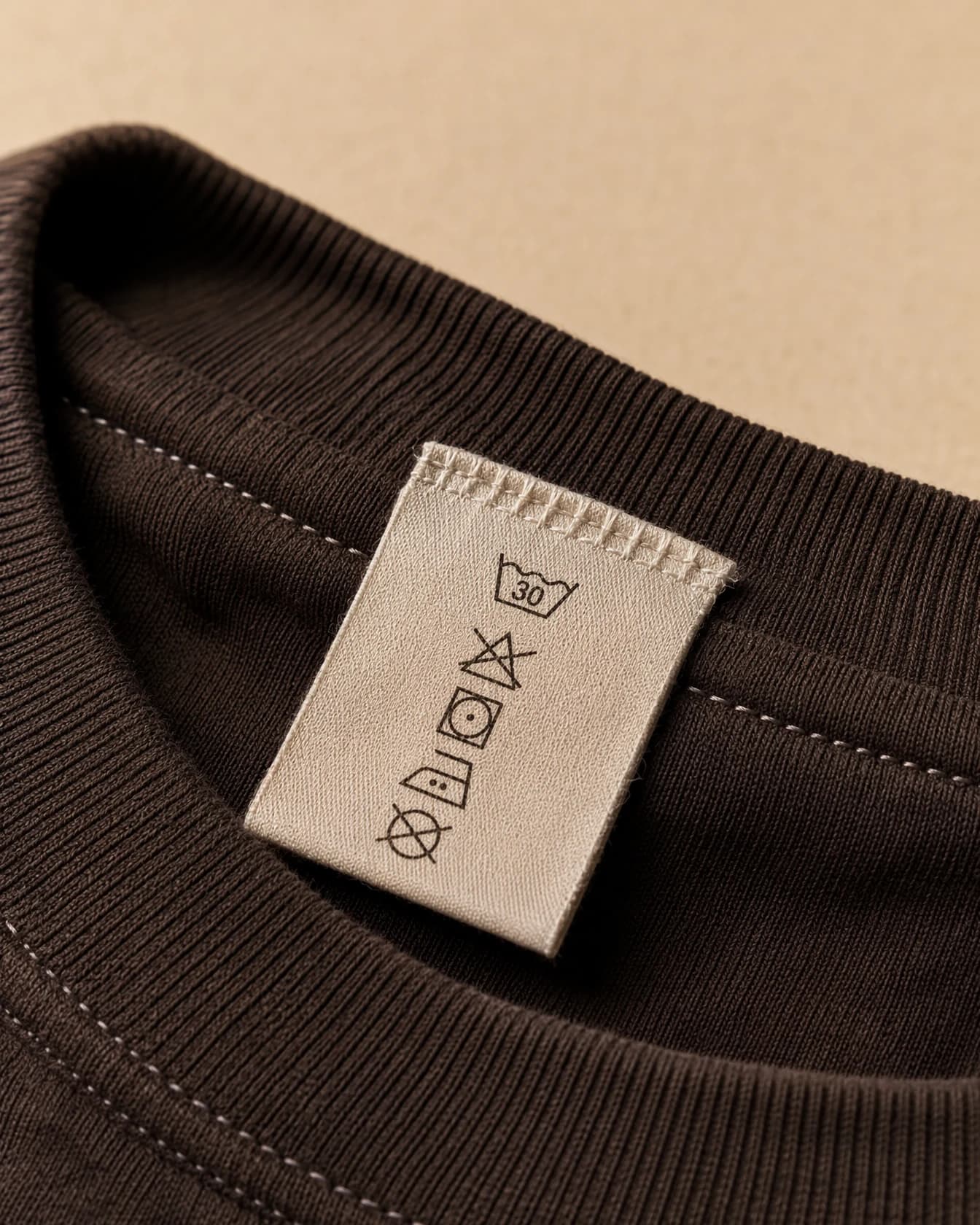
A care label isn't a design decision — in most major markets it's a legal requirement, with specific rules about what information must appear, how permanently, and where. The requirements differ by destination market, and treating one country's rules as universal is a common, avoidable compliance gap for brands selling across multiple regions.
United States
Federal law requires most textile and wool products to carry a label stating fibre content, country of origin, and the identity of the manufacturer or the business responsible for marketing the product. The FTC's Care Labeling Rule separately requires a washing or dry-cleaning instruction on every garment — only one instruction is required if the item can be handled either way.
- "Made in USA" can only be used if the garment was manufactured in the US from US-manufactured materials; a US-sewn garment using imported fabric must say so in a single statement, such as "Made in USA of imported fabric." A garment made abroad names its country in English, for example "Made in Bangladesh", and where the garment has a neck that label sits at the inside centre of the neck.
- The CPSC separately enforces safety standards, including flammability requirements, distinct from the FTC's labeling and fibre-content rules.
European Union and UK
EU law requires one thing on the textile label itself: the fibre composition, under Regulation (EU) No 1007/2011, on a durable, legible label in the official language of each country where the garment is sold. Since 13 December 2024 the General Product Safety Regulation also requires the manufacturer's name and postal and electronic address on the product or its packaging, and a responsible business established in the EU for goods made outside it. Care labeling and country of origin are not mandated EU-wide, though some member states (Austria, for example) do require care symbols — and care instructions are strongly recommended regardless, since EU product liability law can hold manufacturers responsible for defects a missing care label might have prevented. The UK runs its own regime: in Great Britain the legal minimum is fibre content in English, with the producer's name and address under product safety rules; care instructions and country of origin are not legally required there, but anything you do print must not mislead.
Label construction and placement
| Label type | Common use | Note |
|---|---|---|
| Woven label | Brand name, logo, country of origin | Most durable and premium-reading finish |
| Printed / heat transfer label | Care instructions, fibre content | Permanently bonded, doesn't add bulk |
| Hang tag | Brand story, price, sizing at point of sale | Removed by the customer — not a substitute for a sewn-in compliance label |
Labels are commonly placed at the neck, side seam, waistband or hem, and must remain legible for the practical life of the garment — a compliance label that fades or detaches after a few washes doesn't meet the intent of the requirement even if it technically existed at point of sale.
“Traceability from raw material to finished product is the underlying requirement behind every specific labeling rule — the label is simply where that traceability becomes visible to the end customer.”
Frequently asked questions
What information is legally required on a US clothing label?
Fibre content, country of origin, the identity of the manufacturer or marketing business, and a care instruction — washing or dry-cleaning — under the FTC's Care Labeling Rule; only one instruction is required if the garment can genuinely be handled either way. Country-of-origin claims carry their own specific wording rule: "Made in USA" can only be used if the garment was manufactured in the US from US-manufactured materials, and a US-sewn garment using imported fabric must say so in a single statement, such as "Made in USA of imported fabric." A garment made abroad names its country in English, for example "Made in Bangladesh", and where the garment has a neck that label sits at the inside centre of the neck. Separately, the CPSC enforces its own safety standards, including flammability requirements, distinct from the FTC's labeling and fibre-content rules — a garment can satisfy one set of requirements and still fail the other, so both need checking independently rather than assuming one covers the other.
Is a care label required in the EU?
Not universally under EU law, though some individual member states — Austria, for example — do require it, and including care instructions is strongly recommended regardless of whether your specific market mandates it. What EU law does require on the label is the fibre composition, in the official language of each country of sale. The reasoning is practical rather than just legal: EU product liability law can hold manufacturers responsible for defects that a missing care label might have prevented, so skipping it removes a layer of protection even where it isn't strictly compulsory. This is a genuinely different requirement from the US, where the FTC's Care Labeling Rule makes a washing or dry-cleaning instruction mandatory on every garment nationwide — so a US-compliant label doesn't automatically tell you anything about EU compliance, and one market's rule shouldn't be assumed to apply to the other.
Does an EU-compliant label satisfy UK requirements after Brexit?
Not automatically. Post-Brexit, the UK operates its own labeling regime, entirely separate from the EU, under which fibre content in English is the legal minimum, alongside the producer's name and address under product safety rules, while care instructions and country of origin are not legally required — a label built to satisfy EU rules isn't guaranteed to cover everything the UK regime requires, and vice versa. Confirm UK-specific compliance separately rather than assuming EU labeling carries over by default. Whichever market you're labeling for, the underlying requirement is the same: traceability from raw material to finished product, made visible to the end customer through the label. Beyond content, the label also has to remain legible for the practical life of the garment — one that fades or detaches after a few washes doesn't meet the intent of the rule even if it was compliant at the point of sale.
Sources
- 1.US Federal Trade Commission — Threading Your Way Through the Labeling Requirements Under the Textile and Wool Acts
- 2.US eCFR — 16 CFR Part 423, Care Labeling of Textile Wearing Apparel
- 3.Your Europe — Textile label (Regulation (EU) No 1007/2011)
- 4.EUR-Lex — Regulation (EU) 2023/988 on general product safety
- 5.GOV.UK — Textile labelling
We produce and attach compliant woven and printed labels to your destination market's requirements as part of standard production — tell us where you're shipping and we'll confirm exactly what's needed.

Homaira Jashim
Director, Belle Vouz Ltd
Homaira Jashim is a director of Belle Vouz Ltd and a co-founder of Collective Studio Ltd, its group company in Narayanganj. She works with brands from first enquiry to repeat orders.
More about the teamFree tools for clothing brands
MOQ, pricing and AQL calculators, a GSM ⇄ oz converter, a fillable tech pack template and a manufacturing glossary — built by our group company, Collective Studio, free to use.