In short
An AQL (acceptance quality limit) inspection checks a random sample instead of every garment: the lot size and inspection level set the sample size under ISO 2859-1, and the shipment passes if the defects found stay within the agreed limits. Garment orders commonly use AQL 2.5 for major defects, so a 125-piece sample passes with up to seven.
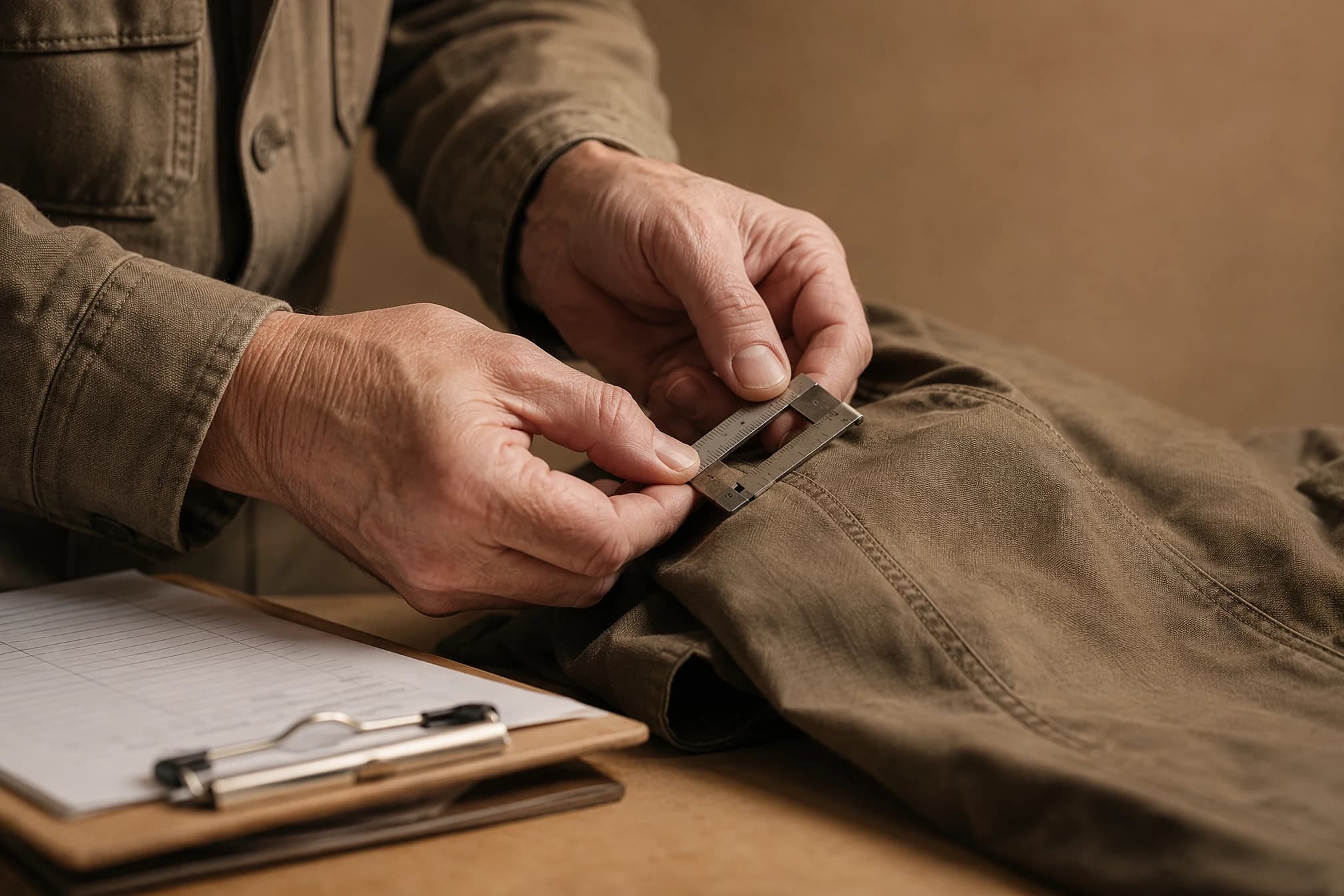
AQL — acceptance quality limit in the ISO standard, and often written Acceptable Quality Limit on inspection reports — is the measure behind the statistical sampling method, set out in ISO 2859-1, that decides whether a shipment passes or fails quality inspection without inspecting every single garment in it. Understanding how it actually works changes how you read an inspection report, and what a "pass" genuinely tells you about the goods you're about to accept.
The core idea: a sample stands in for the whole shipment
Inspecting every piece in a 10,000-unit shipment isn't practical. AQL instead defines a statistically valid sample size based on the total shipment quantity, plus a maximum number of defects allowed within that sample before the entire lot is rejected. This is a decision method built on acceptable statistical risk, not a guarantee that every garment in a passed shipment is defect-free — a passed AQL inspection means the sample gave no statistically significant reason to reject, nothing more.
“AQL is a pass/fail decision built on a sample, not a certificate that every unit is perfect. Understanding that distinction is what separates a buyer who reads inspection reports critically from one who just checks for the word "passed."”
AQL levels — and why 2.5 is the industry default
The AQL level (commonly expressed as a number like 1.5, 2.5, or 4.0) sets how strict the standard is — a lower number means a stricter standard, tolerating fewer defects for the same sample size. AQL 2.5 is the most widely used level in general apparel, striking a practical balance between inspection rigor and cost; brands producing higher-value or safety-critical product sometimes tighten this to AQL 1.5.
Defect classification — not all faults are equal
| Class | Meaning | Example |
|---|---|---|
| Critical | Renders the garment unsafe or unsellable outright | Sharp object left in seam, missing required safety label |
| Major | Likely to affect saleability or customer satisfaction | Visible stitching defect, significant colour shading between panels |
| Minor | Cosmetic, unlikely to be noticed or affect use | A slightly uneven stitch on an internal, unseen seam |
Each class gets its own limit. The usual garment set-up is 0 for critical defects, AQL 2.5 for major and AQL 4.0 for minor, at general inspection level II: on that plan an order of 1,201 to 3,200 pieces is checked on a 125-piece sample, which passes with up to 7 major and up to 10 minor defects and fails on a single critical one. The limits, the inspection level and the defect list are agreed in advance between buyer and factory — specify them in your order confirmation rather than assuming any default.
Who conducts the inspection
Final inspection can be performed by the factory's own QA team, or by an independent third-party inspection company the buyer engages directly — the latter is standard practice for buyers who can't inspect in person, and removes any question of the factory grading its own work. Independent inspection is a small cost relative to the risk of a full shipment reaching you (or your customer) with a real defect rate the factory's own team didn't flag.
Frequently asked questions
What does AQL 2.5 mean?
It's the most common acceptance quality limit (often written Acceptable Quality Limit) used in general apparel inspection. The 2.5 is a percentage: the sampling plans in ISO 2859-1 are built so that lots running at about 2.5% defective or better pass most of the time, and they fix how many defects are tolerated in a sample of a given size before the entire shipment is rejected. The number itself measures strictness: a lower AQL number tolerates fewer defects for the same sample size, and 2.5 has become the industry default because it strikes a practical balance between inspection rigor and cost for standard apparel. Brands producing higher-value or safety-critical product sometimes tighten this to AQL 1.5 instead. Defects are also classified by severity — critical (unsafe or unsellable, like a sharp object left in a seam), major (likely to affect saleability, like a visible stitching defect), and minor (cosmetic, unlikely to be noticed) — and each class normally gets its own limit — commonly 0 for critical, 2.5 for major and 4.0 for minor — which should be agreed and specified in the order confirmation before production runs.
Does a passed AQL inspection mean the shipment has zero defects?
No. AQL is a statistical decision method based on a sample, not a guarantee every unit is defect-free. Inspecting every piece in a large shipment isn't practical, so AQL instead defines a statistically valid sample size based on the total shipment quantity, plus a maximum number of defects allowed within that sample before the whole lot is rejected. A pass simply means the sample gave no statistically significant reason to reject the shipment at the agreed AQL level and defect classification — it says nothing about whether a small number of defective units exist outside that sample. Reading an inspection report as a certificate of perfection rather than a risk-based pass/fail decision is the most common mistake buyers make with AQL results.
Should I use my own inspector or the factory's?
Final inspection can be performed by the factory's own QA team, but an independent third-party inspector, engaged directly by the buyer, is standard practice — it removes any question of the factory grading its own work, since it isn't the same party responsible for producing the goods. This matters most for buyers who can't inspect the goods in person before shipment and would otherwise be relying entirely on the factory's own report. The cost of an independent inspection is small relative to the risk of a full shipment reaching you, or your customer, with a real defect rate the factory's own team didn't flag. Some factories also run inspections at multiple stages — inline, mid-line and final — rather than only at the end, which catches problems earlier in the production run.
Sources
We inspect to AQL 2.5 as standard, at inline, mid-line and final stages, and are happy to accommodate a stricter level or an independent third-party inspector on request. If you want to work out your own sample size and accept/reject threshold before a shipment arrives, our group company Collective Studio built a free AQL calculator for exactly that.
Where to next
- Choosing a clothing manufacturer in Bangladesh — the full guide
- Five ways to manufacture with us — FOB, CMT, private label, OEM, low-MOQ
- Our certifications — who holds which, and how to verify them
- What we manufacture — knit, woven, sweater and leather
- Sourcing by destination market — duty, labelling and lead times
- Get costing, MOQ and a lead-time — usually the same business day

Homaira Jashim
Director, Belle Vouz Ltd
Homaira Jashim is a director of Belle Vouz Ltd and a co-founder of Collective Studio Ltd, its group company in Narayanganj. She works with brands from first enquiry to repeat orders.
More about the teamFree tools for clothing brands
MOQ, pricing and AQL calculators, a GSM ⇄ oz converter, a fillable tech pack template and a manufacturing glossary — built by our group company, Collective Studio, free to use.