In short
Before committing to a leather jacket manufacturer, check that leather is its core trade: inspect three recent leather styles in person, confirm walking-foot, cylinder-arm and skiving machines, and get hide source, grade and Leather Working Group availability in writing. Expect sampling at $150 to $400 per jacket, two to four weeks per round, and two rounds before bulk.
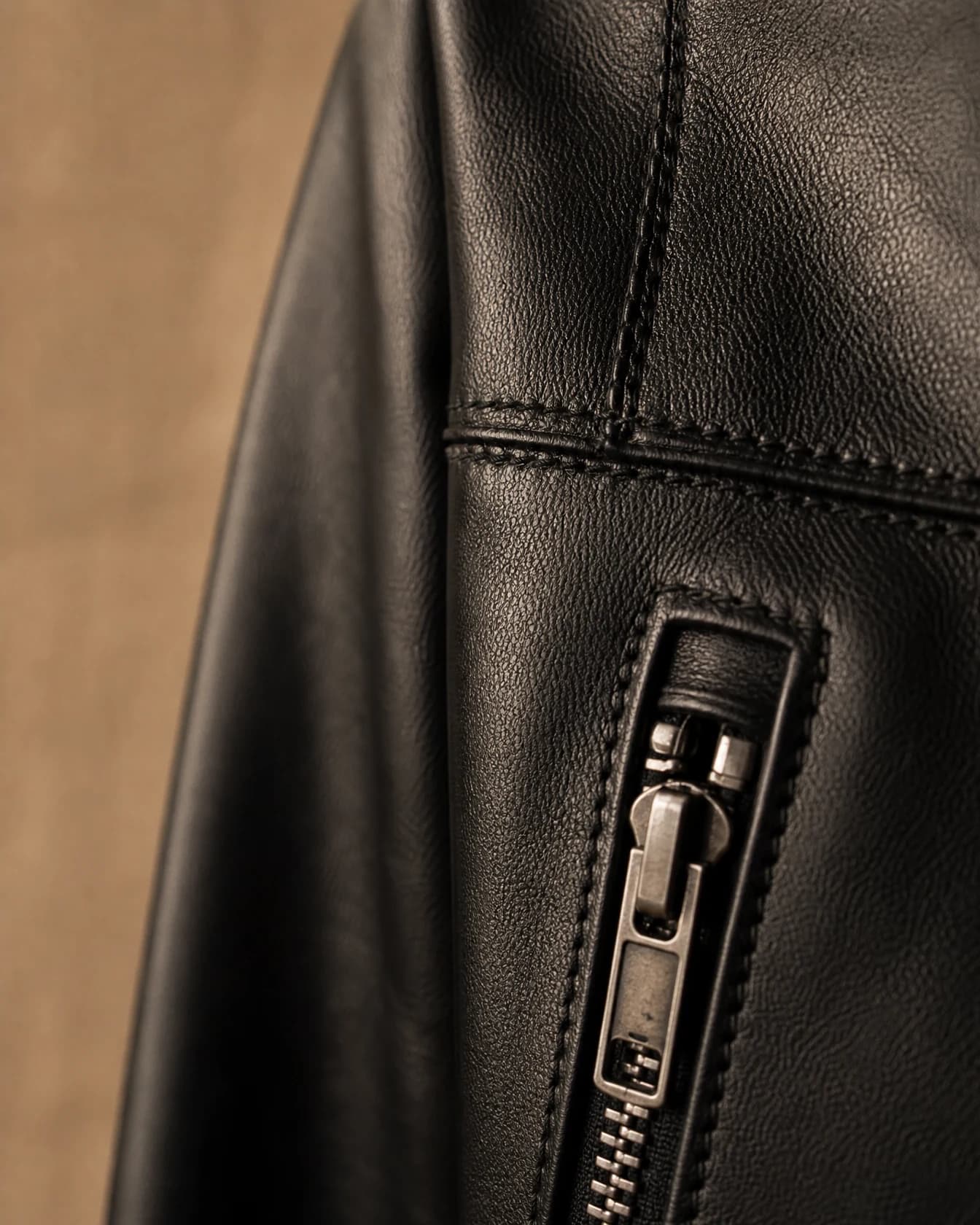
A leather jacket is the most complex single garment most brands will ever commission. It combines a natural material that varies hide to hide, heavy-duty construction closer to bag-making than to sewing knits, hardware that carries real load, and a fit expectation shaped by a century of iconic designs. Choosing the wrong manufacturer here is not a ten-percent problem; it is a whole-order problem.
Here is what to check before you commit — the questions that separate a leather garment factory from a fabric factory that says yes to everything.
First check: is leather actually their trade?
Leather garment production needs walking-foot and cylinder-arm machines, skiving machines to thin seam allowances, press-studs and riveting stations, and operators who have spent years on hides — because leather does not forgive. Every needle hole is permanent; there is no unpicking a seam. Ask directly: what share of your output is leather garments, which machines do you run, and can we see three leather styles you produced in the last year. A factory that mostly sews woven jackets and 'also does leather' is a risk you will discover at the worst possible time.
Hide sourcing and matching
A jacket consumes several hides' worth of panels, and hides vary in grain, shade and softness. Skilled cutters match panels so a single jacket reads as one surface — shoulders and fronts from the cleanest sections, under-arms and facings from the rest. Ask where hides come from (own tannery relationships beat spot-market buying), whether they can hold a consistent supply for repeat orders, and whether Leather Working Group (LWG) audited tanneries are available in your grade. Consistency between order one and order two is the real test of a leather supply chain.
Construction points that define quality
- Seam construction — lapped or welted seams with even 3–3.5 mm topstitching; skived seam allowances so joins lie flat instead of ridging.
- Reinforcement at stress points — pocket corners, cuff zips and hem edges backed internally; hardware set on backing plates, not bare leather.
- Zips and hardware — a heavyweight branded main zip (YKK or equivalent) is the component your customer operates every single wear; economy zips are the most common failure.
- Lining and internals — body linings in viscose or cupro breathe better than cheap polyester; sleeve linings should be slick for entry; internal seams bound, not raw.
- Facings and collar work — the collar roll and front zip facing are where pattern-room skill is visible at arm's length.
- Finishing — pressing and shaping leather is a craft of its own; a well-made jacket arrives with body, not flat-packed creases.
| Spec level | Typical FOB (USD) | Leather | Notes |
|---|---|---|---|
| Entry | $60 – $95 | Split / corrected grain | Price-point retail; limited longevity |
| Mid | $95 – $160 | Top-grain, semi-aniline | The branded sweet spot |
| Premium | $160 – $280+ | Full-grain / aniline lamb or cow | Heirloom-grade, patina develops |
At specialist leather units, MOQs can run lower than cut-and-sew apparel — typically 100–300 pieces per style — because the constraint is skilled labour rather than fabric minimums; our own leather jacket programmes start at 300–500 pieces per style, confirmed against hide availability. Sampling costs more ($150–$400 per jacket) and takes longer (two to four weeks per round), and you should budget two rounds. A leather sample is a significant object; factories that sample cheaply are usually sampling in a different leather than they will ship.
Fit: the part everyone underestimates
Leather barely stretches, so ease has to be engineered where knits would simply give — across the back for reach, at the elbow, through the armhole. Fit your samples over the clothing the jacket will actually be worn with, test the motions (arms forward, arms raised, seated), and expect the leather to relax slightly with wear. A jacket that fits like a woven blazer in the fitting will feel restrictive in life. This is where an experienced leather pattern room earns its keep, and where a generalist one fails invisibly until customers try the product.
The sourcing checklist
- Three recent leather garment references, physically inspected — not photos.
- Machine list including skiving and walking-foot equipment.
- Hide source, grade options and LWG availability in writing.
- A costed spec: leather grade and thickness, lining, zip brand, hardware finish.
- Sampling terms — cost, rounds included, and whether charges credit against bulk.
- Repeat-order shade control: how they manage hide variation between batches.
- Compliance status of the actual production unit — not the group's best factory.
“In leather, every mistake is permanent and every shortcut is visible at one metre. The factory's discipline is the product.”
Frequently asked questions
What is the MOQ for custom leather jackets?
Typically 100–300 pieces per style at specialist leather units, lower than the roughly 500-piece minimums common in cut-and-sew apparel; Belle Vouz's own leather jacket programmes start at 300–500 pieces per style, depending on hide availability. The difference comes down to what's actually constraining the order: in fabric garments the bottleneck is the mill's dye-lot minimum, but in leather it's skilled labour and hide procurement — walking-foot and skiving machinery need experienced operators, and every needle hole is permanent, so there's no fast, low-skill way to scale a leather line the way you can with knits. That labour constraint is also why leather MOQs don't drop much further even for a smaller brand: a factory geared for leather production has the same skilled hands whether it's cutting 100 jackets or 300. Expect sampling costs of $150–$400 per jacket and two to four weeks per round on top, and budget for two rounds before committing to bulk.
How much does it cost to manufacture a leather jacket?
Roughly $60–$95 FOB for entry-level specs built from split or corrected-grain leather, aimed at price-point retail with limited longevity. Mid-tier construction in top-grain, semi-aniline leather — the branded sweet spot most private-label programmes land on — runs $95–$160. Premium builds in full-grain or aniline lamb or cowhide, the heirloom-grade specs that develop a genuine patina over years of wear, run $160–$280 or more. The leather itself accounts for half the total cost or more at every tier, which is why grade selection matters more than any other single decision on the cost sheet. Sampling adds a separate cost on top — $150–$400 per jacket per round, with two rounds typically needed — and factories that sample cheaply are usually sampling in a different leather than they intend to ship in bulk.
How long does leather jacket production take?
Two to four weeks per sample round, and you should budget for two rounds rather than assuming the first sample will be approved — leather is unforgiving of correction once cut, so getting fit and construction right before bulk matters more here than in almost any other category. After sampling, bulk production typically runs eight to twelve weeks, with the range depending mainly on hide procurement and order quantity: hides vary in grain, shade and softness, and skilled cutters need time to match panels so a single jacket reads as one consistent surface, which isn't a step that can be rushed without the finished garment looking patched together. Factories with their own tannery relationships, rather than ones buying hides on the spot market, tend to hold shorter and more predictable procurement timelines for repeat orders.
Lambskin or cowhide?
Lambskin is softer, lighter and drapes beautifully, which makes it the fashion choice for jackets meant to move and flatter rather than take abuse — the trade-off is that it marks and scuffs more easily than heavier hides. Cowhide is heavier, tougher and considerably more abrasion-resistant, which is why it's the standard choice for biker and workwear styles that need to survive real wear. Goat leather sits usefully between the two, offering some of cowhide's durability without lambskin's fragility, for programmes that want a middle ground. Whichever you choose, the grade within that hide type matters as much as the animal: full-grain and top-grain lamb or cowhide will develop a patina and outlast split or corrected-grain versions of the same hide by a wide margin, particularly at the premium end of the price range.
How do I verify a factory can really make leather jackets?
Inspect recent leather production physically rather than trusting photographs — ask to see three leather styles the factory produced in the last year and examine the stitching, seam allowances and hardware setting directly. Confirm they run the specific machinery leather requires: walking-foot and cylinder-arm machines for heavy-duty seams, skiving machines to thin seam allowances so joins lie flat, plus press-stud and riveting stations. And ask directly what share of their total output is leather garments — a factory that mostly sews woven jackets and 'also does leather' is a different risk profile from one where leather is the core trade. Fabric factories dabbling in leather tend to reveal themselves on all three checks: thin or absent machine lists, no recent leather references to show, and evasive answers about output mix. Also ask about hide sourcing and whether LWG-audited tanneries are available in your target grade, since consistency between your first and second order is the real test of the supply chain.
Does Bangladesh produce leather jackets?
Yes — Bangladesh has a substantial leather sector operating alongside its much larger garment industry, with the specialised machinery, skilled labour and hide-handling experience that leather construction requires being genuinely distinct from cut-and-sew apparel production. That distinction matters when sourcing there: a general apparel factory that also claims to do leather is a different proposition from a specialised leather unit, so the same verification questions apply — ask about machine lists, hide sourcing, and recent leather references regardless of country. Belle Vouz runs leather jacket and leather goods programmes through specialised partner units rather than through general apparel lines, with hide sourcing handled in-house rather than bought speculatively on the spot market, which is what supports consistent grain, shade and quality across repeat orders rather than just a single one-off sample.
Send us a reference jacket or a sketch with a target price, and we will come back with a leather grade, a construction spec and an honest sample plan — including what your price point can genuinely carry.

Homaira Jashim
Director, Belle Vouz Ltd
Homaira Jashim is a director of Belle Vouz Ltd and a co-founder of Collective Studio Ltd, its group company in Narayanganj. She works with brands from first enquiry to repeat orders.
More about the teamFree tools for clothing brands
MOQ, pricing and AQL calculators, a GSM ⇄ oz converter, a fillable tech pack template and a manufacturing glossary — built by our group company, Collective Studio, free to use.