In short
A bag's quality is decided by what is hidden: interlining, board and foam give it structure, bartacks and reinforced anchors carry the load, and a branded zip such as YKK removes the most common failure point. Indicative FOB prices run from $2.50 to $6.00 for a 12 oz canvas tote to $25 to $60 or more for a leather tote.
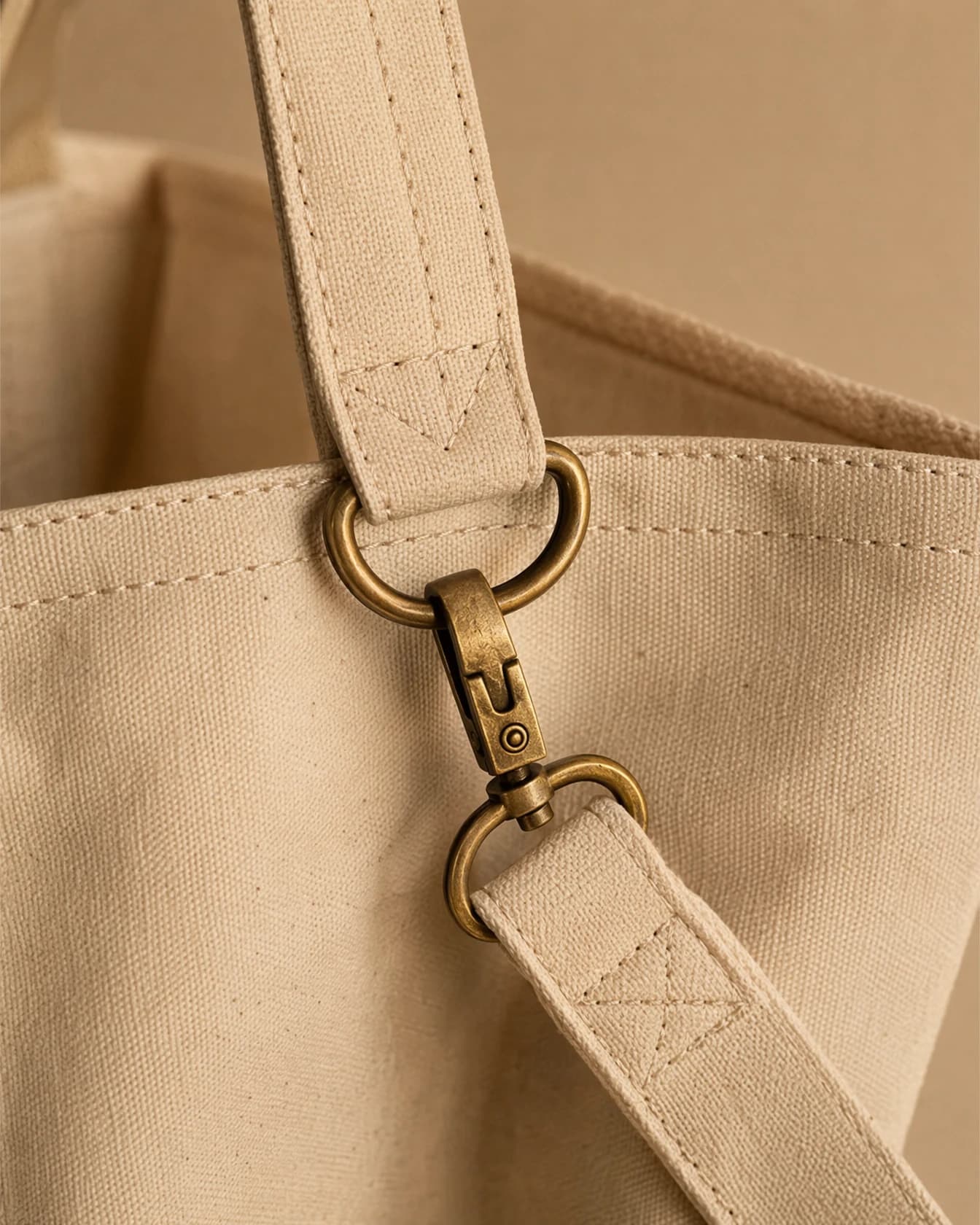
Two bags in the same material can feel completely different in the hand. The reasons are usually invisible from the outside: structure, hardware and lining. A tote that slumps, a zip that snags, a strap that pulls loose at the anchor point — none of these show up in a product photo, and all of them show up in reviews.
This guide covers how bags are actually constructed, which materials suit which product, the hardware decisions that quietly set your quality tier, and what MOQs and prices look like when you manufacture private-label bags.
Materials: the outer is only half the story
- Cotton canvas (10–16 oz) — the workhorse for totes and casual bags; heavier weights stand up on their own, lighter ones fold flat.
- Waxed canvas — water-resistant, ages with character; needs different needles and seam handling in production.
- Full-grain and top-grain leather — premium structure and patina for briefcases, satchels and straps; price and QC demands rise accordingly.
- PU and microfibre synthetics — consistent, animal-free and cost-effective; quality varies enormously between suppliers, so approve a physical swatch.
- Recycled polyester (rPET) and nylon — light, strong and increasingly requested; look for GRS-certified supply if you plan to make claims.
Whatever the outer, ask what sits behind it. Reinforcement fabric, foam and board decide whether the bag holds its shape, and a beautiful outer over a flimsy internal build is the most common private-label disappointment.
Structure: why some bags stand and others slump
Whether a bag holds its shape comes from interlining and reinforcement — not the outer material alone. Bases are stiffened with board or padded with foam; side panels may carry fusible interlining; handles and strap anchors are reinforced with hidden webbing or rivet-backed patches. Totes can be deliberately soft; laptop bags and backpacks need engineered support, padded compartments and often a false bottom. On backpacks, the back panel and strap construction — foam density, mesh overlay, bartack positions — are the product.
Construction details that signal quality
- Bound or taped internal seams instead of raw overlocked edges.
- Bartacks at every stress point: strap anchors, zip ends, handle roots.
- Even topstitching at 6–8 stitches per inch on structural seams.
- Strap webbing that matches load: a laptop bag needs seatbelt-grade, not dress-grade.
- Base feet or a reinforced base panel on bags meant to be set down.
Hardware: the difference you can hear
Hardware is where cost-cutting is easiest and most audible. Zips are the single most important component — a branded zip such as YKK or an equivalent-grade alternative costs more per unit and removes the most common failure point in the entire product. Buckles, D-rings, sliders and magnetic snaps come in plated zinc alloy at the premium end and painted lightweight alloys at the economy end; the weight difference is immediately felt. Specify finish (nickel, gunmetal, antique brass), and require salt-spray or wear testing if the finish is part of your brand look.
| Product | Typical FOB (USD) | Common MOQ | Main cost drivers |
|---|---|---|---|
| Cotton canvas tote (12 oz) | $2.50 – $6.00 | 500 | Canvas weight, print method, handles |
| Zip-top daily tote, lined | $6.00 – $12.00 | 500 | Lining, zip brand, base structure |
| Backpack (poly/nylon) | $8.00 – $18.00 | 500–1,000 | Panel count, padding, hardware grade |
| Crossbody / messenger | $7.00 – $15.00 | 500 | Hardware count, lining, adjusters |
| Leather tote or satchel | $25.00 – $60.00+ | 300 | Leather grade, edge finishing, hardware |
Lining and interior architecture
The lining is the part your customer touches every day. Polyester twill is standard; cotton drill reads natural; jacquard linings carry branding. More important than the fabric is the interior layout — pocket count and placement, padded sleeve dimensions, key leash, water bottle gusset. Specify interior architecture in the tech pack with the same precision as the outside, including pocket dimensions and their positions from seams.
Testing before bulk
Bags are load-bearing products, so ask your manufacturer for simple performance checks on the pre-production sample: a static load test on handles and straps (a loaded bag hung for 24 hours), zip cycle testing, colour rub (crocking) tests on deep shades, and a rain check on anything marketed as water-resistant. These tests are quick and cheap before production and impossible after.
Frequently asked questions
What is the MOQ for private-label bags?
Typically 500 pieces per style for sewn fabric bags (500–1,000 for backpacks), and around 300 for leather bags. Below that, factories either decline or price the setup into the unit cost. The gap between the two reflects value rather than difficulty: leather goods carry a much higher unit price — often $25 and up versus $2.50–$18 for canvas, poly or nylon products — so a smaller run still justifies the pattern, cutting and hardware setup a factory has to do regardless of quantity. Sewn fabric bags such as totes, backpacks and crossbody bags typically ask for 500 pieces per style because the hardware, lining and trims are sourced specifically for your order rather than pulled from stock. If you need a smaller test run, expect the factory to either quote a setup surcharge or decline the order outright.
How much does it cost to manufacture a tote bag?
A basic 12 oz canvas tote runs roughly $2.50–$6.00 FOB at moderate volume, with canvas weight, print method and handle construction as the main cost drivers — a heavier canvas that stands on its own costs more than a lighter one that folds flat. Adding a zip top, lining and internal pockets moves it to $6.00–$12.00, because now the lining fabric, zip brand and base structure all factor in: a branded zip and a properly stiffened base cost more than an open tote with no closure. Both prices assume moderate volumes around 500 pieces; larger runs bring the unit price down as setup costs spread further. Ask your factory to itemise which line items move the price before you lock a spec, so you know exactly what you're paying for.
Should I insist on YKK zips?
On anything load-bearing or daily-use, a branded or equivalent-grade zip is the cheapest insurance you can buy — zips are the most common failure point in bags, and a slider or tape that fails is what turns a returned product into a lost customer. A branded zip such as YKK costs more per unit than an unbranded alternative, but that premium is small compared with the cost of a bulk order failing in the field. It's worth asking your factory to run zip cycle testing on the pre-production sample specifically, not just a general quality pass, since this is the one component that gets used every single day a bag is owned. For decorative or occasional-use bags the case is weaker, but for daily totes, backpacks and crossbody bags it isn't worth the risk.
Can bags be made with recycled materials?
Yes — recycled polyester (rPET) and nylon outers and linings are widely available, and they're increasingly requested because they're light, strong and hold colour well, which suits sports-oriented and casual bag styles. If you plan to market the recycled content — on a hangtag or product listing — source GRS-certified material so the claim is auditable; unverified recycled-content claims are an easy target for scrutiny. The same caution applies to synthetics generally: PU and microfibre alternatives are consistent and cost-effective, but quality varies enormously between suppliers, so always approve a physical swatch before committing to a fabric, recycled or not. Recycled content doesn't change the construction requirements either — reinforcement, hardware grade and lining still need the same scrutiny as a virgin-material bag.
What tests should a bag pass before bulk?
Handle and strap load tests, zip cycling, colour-fastness rub tests, and a water resistance check where relevant — all run on the pre-production sample, before bulk fabric is cut. The load test is the most telling: hang a fully loaded bag from its handles or straps for 24 hours and see whether the anchor points, webbing and stitching hold without stretching or tearing. Colour rub, or crocking, tests matter most on deep shades, where dye can transfer onto clothing or skin with wear. None of these tests are expensive or slow to run at sample stage, and all of them are effectively impossible to fix once a bulk order of hundreds or thousands of units already exists — which is exactly why they belong before bulk, not after a customer complaint.
How long does bag production take?
Sampling typically takes two to three weeks because of component sourcing — hardware like zips, buckles, D-rings and sliders often has to be procured to match your specified finish and grade before a sample can even be built, unlike a plain fabric garment. Bulk runs six to ten weeks depending on hardware lead times and quantity, with more complex products taking longer: a structured backpack with padded compartments and multiple hardware pieces moves slower through a line than a simple unlined canvas tote. Leather goods add their own lead time for hide sourcing and edge finishing. If your timeline is tight, specifying hardware and materials already in a factory's stock range — rather than a custom finish or plating — is usually the fastest lever available.
A good bag is engineered from the inside out. Send us a reference product or a sketch and we will spec the structure, hardware and lining honestly — including where you can save and where you should not.

Homaira Jashim
Director, Belle Vouz Ltd
Homaira Jashim is a director of Belle Vouz Ltd and a co-founder of Collective Studio Ltd, its group company in Narayanganj. She works with brands from first enquiry to repeat orders.
More about the teamFree tools for clothing brands
MOQ, pricing and AQL calculators, a GSM ⇄ oz converter, a fillable tech pack template and a manufacturing glossary — built by our group company, Collective Studio, free to use.