In short
Private-label socks are specified by needle count, yarn and finishing: 108 to 120 needles suits standard crew and athletic socks, 144 finer everyday socks and 168 to 200 dress socks and detailed jacquard. A quality athletic sock is about 75 to 85% cotton with nylon and elastane, and typical minimums are 1,000 to 3,000 pairs per design and colourway.
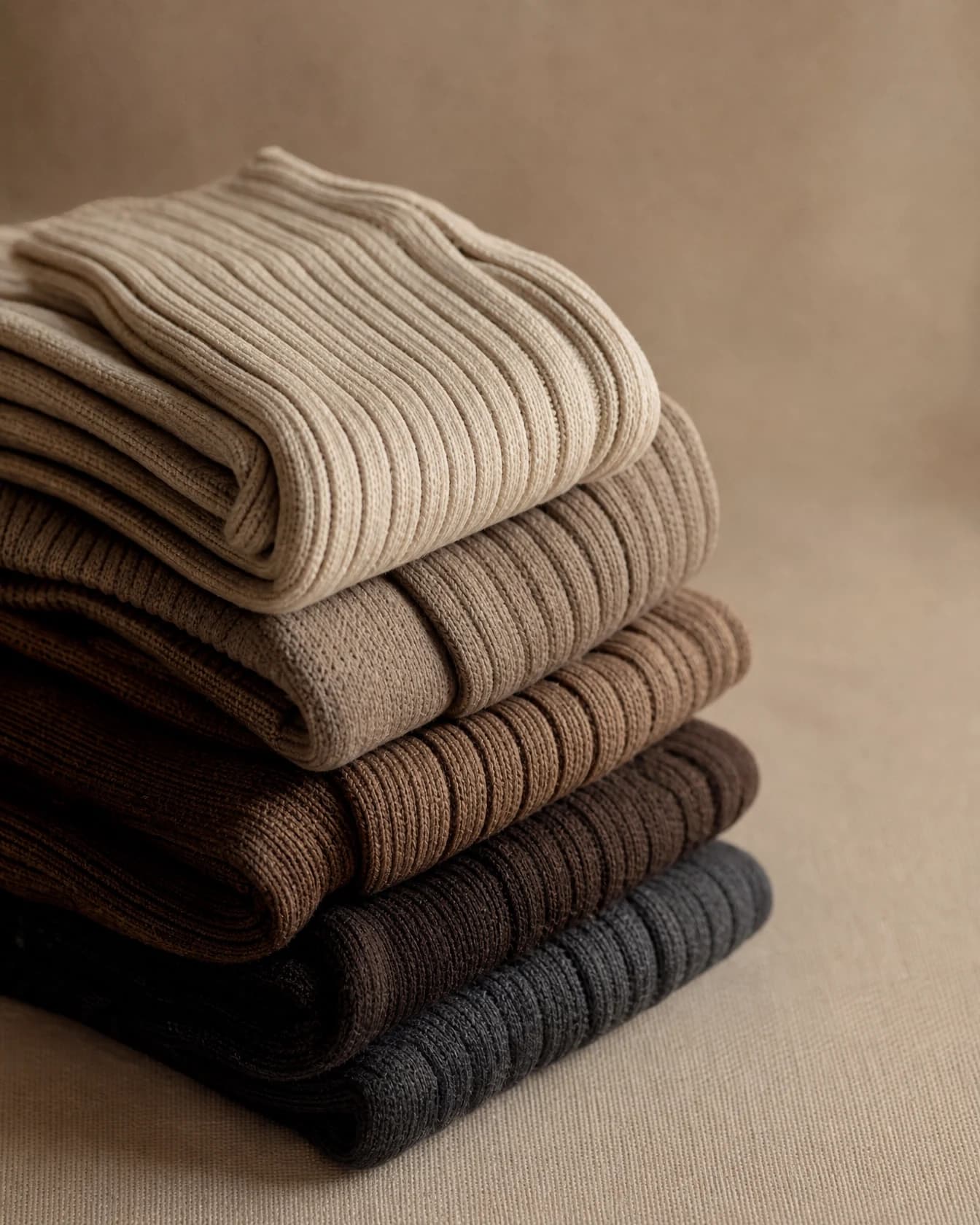
A sock is a small product with a lot of engineering in it. Get the gauge, yarn and finishing right and it stays up, keeps its shape and lasts; get them wrong and it does none of those things. Because the whole product is knitted in one automated pass, almost every quality decision is locked in before the first sock exists — which makes the specification stage matter more here than in almost any other category.
Gauge and needle count: the resolution of a sock
Socks are knitted on circular machines rated by needle count — the number of needles around the cylinder. Higher counts give finer, smoother knits with sharper pattern detail; lower counts give chunkier, loftier fabric. As a working map: 84–96 needles for chunky boot and heavy ragg socks, 108–120 for standard crew and athletic socks, 144 for finer everyday socks, and 168–200 for dress socks and detailed jacquard designs. Your design should choose the machine: fine multi-colour artwork on a 108-needle machine comes out blocky, and there is no fixing it in finishing.
Terry, ribs and mesh
Cushioned athletic socks use terry loops knitted on the inside — full-terry for maximum cushioning, half-terry zoned under the foot only. Ribs at the leg control stay-up; mesh zones over the instep add ventilation. All of these are knitting programme decisions, specified per zone in the tech pack.
Yarn: what the sock is actually made of
- Combed cotton — the everyday standard; smoother and stronger than carded. Mercerised cotton adds sheen for dress socks.
- Cotton-polyester blends — add durability and lower cost; standard for athletic ranges.
- Merino wool blends — temperature regulation and odour control for boot and outdoor socks, at a real yarn premium.
- Nylon and elastane — the invisible workhorses: nylon plated for abrasion resistance at heel and toe, elastane (often as covered Lycra) throughout for recovery, plus a spandex-covered welt at the cuff.
- Recycled cotton and rPET yarns — increasingly available; certify the supply chain (GRS) if you plan to make claims.
A typical quality athletic sock is roughly 75–85% cotton with the balance in nylon and elastane. A '100% cotton sock' is a product that will not stay up — the stretch components are not impurities, they are the engineering.
The details that separate good from cheap
| Detail | Economy version | Quality version | Why it matters |
|---|---|---|---|
| Toe closure | Rosso seam (visible ridge) | Hand-linked / seamless toe | The ridge is felt with every step |
| Heel | Tube (no heel pocket) | True knitted heel pocket | Fit, and whether it twists in wear |
| Cuff | Single thin welt | Deep ribbed welt, covered elastane | Stay-up without garrotting |
| Reinforcement | None | Nylon-plated heel and toe | Where every sock dies first |
| Finishing | Tumbled only | Boarded (heat-set on foot forms) | Shape, size accuracy, presentation |
Hand-linked toes are the single clearest quality tell in the category — they need a separate operation (or premium machines that close the toe automatically) and cost cents more per pair, which is exactly why cheap programmes skip them.
Sizing, MOQ and price
Socks compress a full footwear size range into three or four knitted sizes (e.g. 35–38, 39–42, 43–46), which keeps size-run complexity manageable. Typical MOQs run 1,000–3,000 pairs per design and colourway — driven by yarn minimums and machine programming time — with indicative FOB prices around $0.60–$1.20 for standard crew socks, $1.00–$2.00 for cushioned athletic styles with jacquard branding, and $1.80–$3.50 for merino blends. Packaging (headers, bands, boxed sets) is a meaningful share of landed cost in this category and worth designing early.
Quality control on a knitted product
Sock QC is about consistency: pair matching (length and colour), leg length within tolerance, welt recovery after stretch, no dropped stitches or holes at the linking line, and print/jacquard alignment. Boarding — heat-setting the sock on a foot form — is what makes retail presentation crisp; ask whether it is included, because tumbled-only finishing looks it.
Frequently asked questions
What is the MOQ for custom socks?
Typically 1,000–3,000 pairs per design and colourway, set primarily by two constraints: the yarn mill's minimum purchase and the time needed to programme a circular knitting machine for your specific pattern and needle count. Because the entire sock is knitted in one automated pass, the machine has to be set up and programmed before a single pair exists, and that setup cost is what the minimum is protecting against being spread over too few pairs. Multi-colour jacquard designs sit at the higher end of that range, since more colours and more detailed patterning mean more complex programming and more yarn changeovers during the knitting cycle. Simpler designs on standard needle counts, using stock yarns rather than custom blends, tend to land toward the lower end of the range and are the fastest way to keep a first sock order manageable.
How much do private-label socks cost to make?
Roughly $0.60–$1.20 FOB for standard crew socks in combed cotton, $1.00–$2.00 for cushioned athletic styles that add terry loop cushioning and jacquard branding, and $1.80–$3.50 for merino wool blends, which carry a real yarn premium for their temperature-regulating and odour-control properties over cotton. Needle count, yarn composition and construction details all move the price within those ranges — hand-linked toes and true knitted heel pockets cost a few cents more per pair than the economy alternatives but are the clearest markers of a quality sock. Packaging is worth budgeting separately and early: headers, bands and boxed sets represent a meaningful share of landed cost in this category relative to the sock itself, so it shouldn't be an afterthought once the knitting spec is locked.
What needle count should I choose?
108–120 needles covers most standard crew and athletic sock programmes — it's the middle of the range and handles typical logos and stripe patterns well. Move up to 144 needles for finer everyday socks, or 168–200 for dress socks and detailed jacquard artwork where the design has fine lines or small text that needs sharp resolution. At the other end, 84–96 needles produces the chunkier, loftier fabric suited to boot socks and heavy ragg styles, where warmth and cushioning matter more than pattern detail. The needle count is essentially the resolution the artwork has to work within, and it needs to be chosen before the design is finalised rather than after: fine multi-colour artwork knitted on a 108-needle machine comes out blocky, and there is no way to fix that in finishing once it's off the machine.
Why do some socks slide down?
Usually one of three specification shortfalls: not enough elastane in the yarn blend, a cuff welt that's too shallow or made from a single thin strand rather than a deep ribbed construction, or a heel knitted as a plain tube instead of a true knitted heel pocket that anchors the sock's shape to the foot. All three are decisions made at the specification stage, not manufacturing defects — a '100% cotton sock' is a sock built without the stretch components that keep it in place, since elastane and nylon aren't impurities in the yarn, they're the engineering that makes a sock function. A properly specified sock uses a deep ribbed welt with covered elastane at the cuff, plated nylon at stress points, and a true heel pocket, and typically runs somewhere around 75–85% cotton with the balance in nylon and elastane doing that structural work.
What is a hand-linked toe?
A hand-linked toe is closed stitch-by-stitch, either by hand or on premium machines built to close the toe automatically, so the finished seam lies flat against the foot instead of forming a visible ridge. The alternative, a Rosso seam, is faster and cheaper to produce but leaves a noticeable ridge that's felt with every step, particularly in athletic or all-day wear. Hand-linking needs a separate operation from the main knitting run, and costs only cents more per pair — which is exactly why cheap sock programmes skip it, since it's a real added labour step even though the material cost difference is negligible. Of all the construction details that separate a good sock from a cheap one — toe closure, heel construction, cuff welt, reinforcement, finishing — the toe is the single clearest and most easily checked marker of which tier a programme sits in.
Can socks be made from organic or recycled yarn?
Yes — organic cotton certified under GOTS and recycled cotton or rPET yarns certified under GRS are both increasingly available for sock production, usually at a 10–25% premium over standard combed cotton yarn. If you plan to make an organic or recycled claim on the finished product, the certification needs to cover the actual yarn supply chain used for your order, not just be available in general from the mill — that's what an auditor or a retailer's compliance team will ask to verify. MOQs can run higher than standard programmes because sourcing certified or recycled yarn in smaller batches is harder for the mill than pulling from a standard stock position, so build extra lead time and a slightly higher minimum into the plan if you're specifying either option for a first order.
Send us your design and target retail price, and we will translate it into needle count, yarn spec and construction — and tell you honestly which details your price point can and cannot carry.
Homaira Jashim
Director, Belle Vouz Ltd
Homaira Jashim is a director of Belle Vouz Ltd and a co-founder of Collective Studio Ltd, its group company in Narayanganj. She works with brands from first enquiry to repeat orders.
More about the teamFree tools for clothing brands
MOQ, pricing and AQL calculators, a GSM ⇄ oz converter, a fillable tech pack template and a manufacturing glossary — built by our group company, Collective Studio, free to use.