Sock manufacturer in Bangladesh
Belle Vouz makes private-label crew, ankle and athletic socks in Bangladesh in cotton and cotton-nylon-spandex blends, from 1,000 pairs per style. We publish the cost breakdown rather than a price, because yarn, decoration and volume move it too far.
Overview
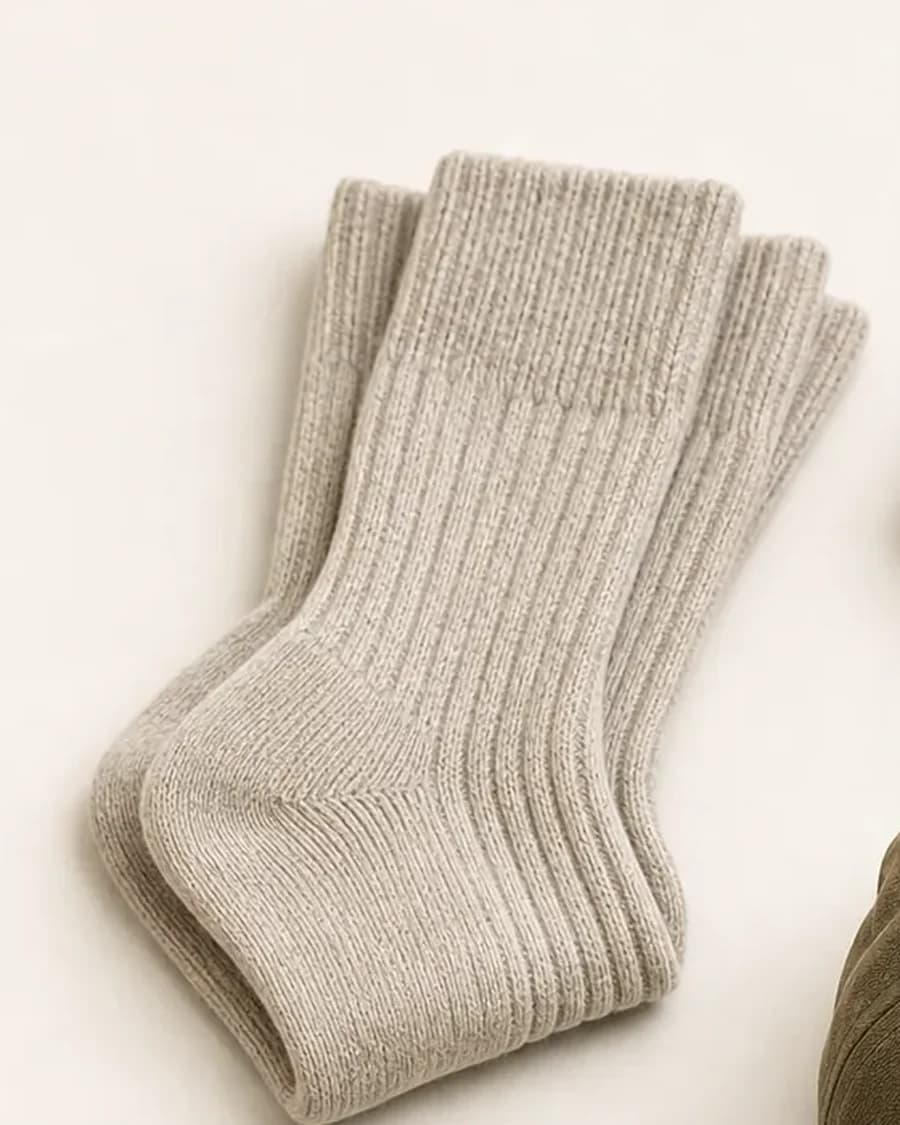
Crew, ankle and athletic socks built on ribbed-cuff knit construction, where yarn blend and knitting gauge decide fit, durability and how the sock holds its shape wash after wash. A typical quality athletic sock runs roughly 75 to 85% cotton with the balance in nylon and elastane — a genuinely 100% cotton sock will not stay up, since the stretch components are engineering for fit, not impurities to be minimised. Hand-linked toes are the single clearest quality tell in the category: they require a separate operation, or premium machines that close the toe automatically, and cost a few extra cents per pair, which is exactly why cheap programmes skip them. MOQ here runs higher than most categories — circular knitting machines are set up per style-colour combination, and that setup cost is only efficient at volume well above cut-and-sew garment thresholds.
What's actually in the spec.
There's no honest single number to publish here.
Socks pricing varies too much by leather grade, hardware and volume for a general range to mean anything. Here's what actually makes up the FOB price, so you can read a quote line by line instead of taking a number on faith.
| Cost component | Share of FOB | What it covers |
|---|---|---|
| Fabric | 38–52% | Yarn, knitting or weaving, dyeing, finishing |
| Trims & accessories | 5–12% | Labels, zips, buttons, thread, elastic, packaging |
| CM (cut & make) | 15–25% | Cutting, sewing, finishing, factory overhead |
| Wash / print / embroidery | 0–15% | Optional decoration — adds up fast |
| Factory margin & compliance | 8–12% | Audits, certifications, testing |
1,000+ pairs per style — higher than most categories due to knitting-machine setup
8–12 weeks from approved tech pack to ex-factory
What buyers ask about socks.
Why can't a sock be 100% cotton?
Because a genuinely 100% cotton sock will not stay up, and this isn't a marketing exaggeration — cotton alone has essentially no stretch recovery, so a sock knitted purely from it loosens and slides down the leg within a single wear. The nylon and elastane in a typical sock blend, commonly 15 to 25% of the total combined, aren't impurities diluting a "pure" product; they're the engineering that gives the sock its fit and lets it snap back into shape after stretching over a foot and ankle repeatedly through a day. A quality athletic sock runs roughly 75 to 85% cotton with the balance in these stretch fibres, and that ratio is what actually determines whether the sock performs — a higher cotton percentage sounds more premium on a label, but past a certain point it comes at the direct cost of the sock actually staying up.
Why is sock MOQ higher than for tees?
Circular knitting machines are set up per style and colour combination, and that setup process — threading yarn, programming the knit pattern, dialling in tension — takes real time regardless of whether the run is 500 pairs or 5,000. That fixed setup cost is only efficient at a higher volume than cut-and-sew garments need, because a tee's setup (cutting a marker, threading a sewing machine) is comparatively fast and cheap to redo for a small run, while a circular knitting machine's setup genuinely isn't. This is a machine-economics constraint, not an arbitrary minimum a factory picked to be difficult — it's why sock MOQ commonly runs 1,000+ pairs per style even at factories that will happily accept a 300-piece order on a cut-and-sew tee.
Can a logo be knitted directly into the sock?
Yes — jacquard knitting builds a logo or pattern directly into the fabric structure during the knitting process itself, using different coloured yarns fed in at specific points in the knit, rather than adding decoration to the finished sock afterward the way embroidery or printing would. The result is more durable than embroidery on a small format like a sock, since the design is structurally part of the fabric rather than sitting on top of it and vulnerable to snagging or wearing off. Jacquard does need to be programmed into the knit pattern at the same setup stage as the sock's basic construction, so it has to be specified upfront rather than added as an afterthought — but for a logo or brand mark that needs to survive repeated wear and washing, it's a genuinely more durable choice than any decoration applied after knitting.
Ready to cost your sock programme?
Send a reference and a target quantity — we'll come back with construction options, costing and lead-time, usually the same business day.