In short
A good commercial hoodie uses 280 to 320gsm fleece, with 340gsm and above for heavyweight streetwear, in either brushed fleece or unbrushed loopback (French terry). Cotton-polyester blends such as 80/20 hold their shape better than 100% cotton, which commonly shrinks 5 to 8% on first wash unless pre-shrunk.
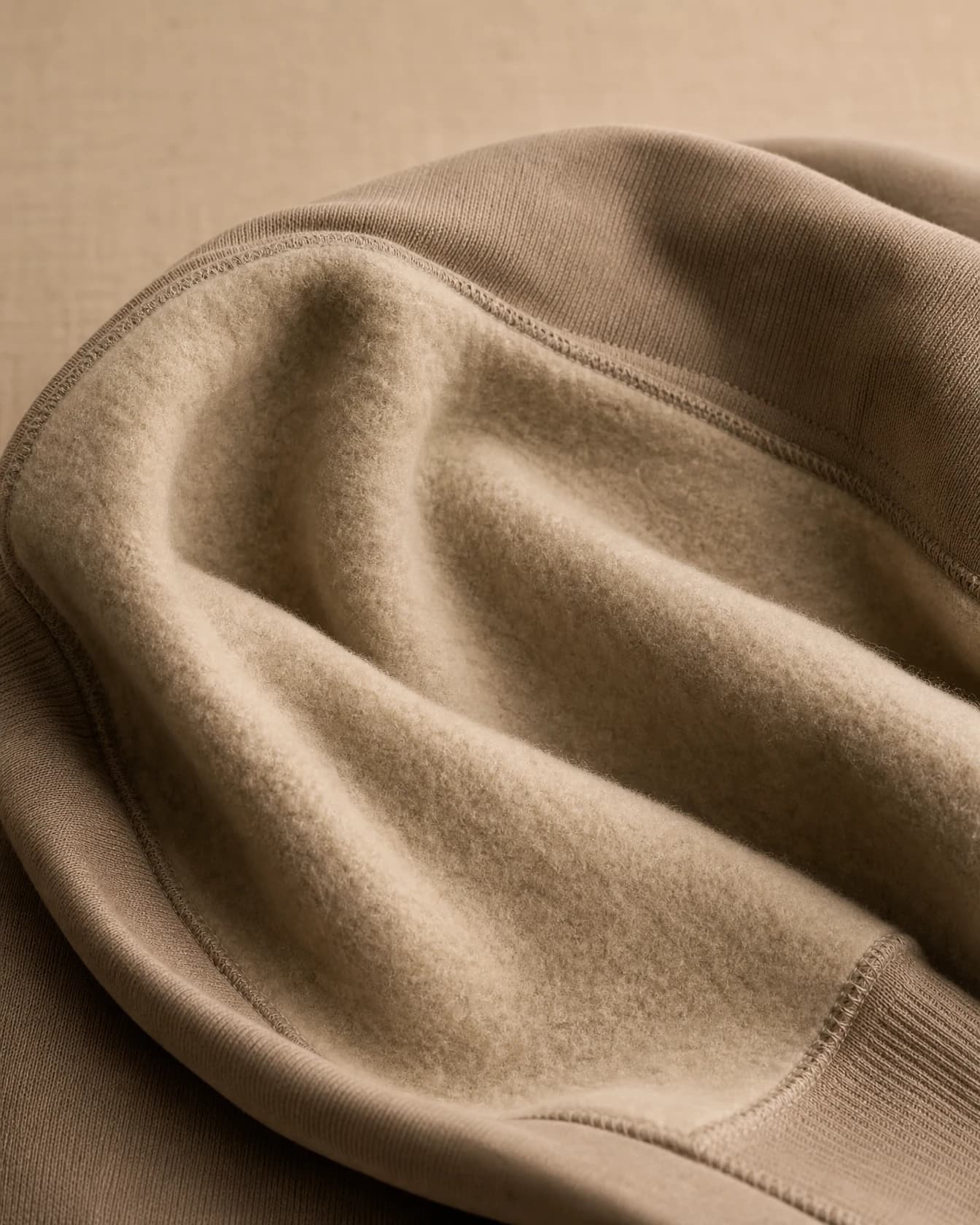
A hoodie is one of the simplest garments to sketch and one of the easiest to get wrong in production. There's no complicated pattern or fine tailoring to hide behind — every decision about fleece weight, brush and construction shows up directly in how the finished piece feels, and how it holds up after twenty washes.
Fleece weight decides almost everything
| GSM range | Feel | Best for |
|---|---|---|
| 200–260gsm | Light, breathable, minimal bulk | Warm-climate hoodies, athleisure layering |
| 280–320gsm | The classic mid-weight hoodie feel | Everyday hoodies and crewneck sweatshirts |
| 340–400gsm+ | Heavy, substantial, premium hand-feel | Streetwear, premium fleece, cold-climate outerwear-adjacent pieces |
Two fleece finishes, three trade names
- Loopback fleece — the knit loops are left exposed on the inside rather than brushed, giving a slightly textured, more fashion-forward look and feel, often associated with premium streetwear. Loopback and French terry are two names for the same unbrushed construction.
- Brushed fleece — the standard hoodie fabric, where the inside loops are mechanically brushed into a soft, fuzzy nap. Warmer-feeling than loopback for the same weight, and the most common commercial choice.
- French terry — another name for loopback: the loops are left unbrushed, with a flatter, more breathable inside face than brushed fleece. Common for warm-weather sweats and lighter-weight hoodies.
Construction details that separate cheap from good
- Cuff and waistband rib — 2x2 rib recovers its shape better over repeated wear than 1x1 rib, particularly at the cuffs, where stretching is constant.
- Drawcord — flat cord with a metal or reinforced tip lasts longer and threads more easily than round cord with a plain plastic tip, which fractures and frays with wear.
- Kangaroo pocket — bartack reinforcement at the pocket's stress points (top corners) prevents the most common hoodie failure point: a torn pocket seam.
- Hood lining — a jersey-lined hood sits better against the neck and doesn't pill as visibly as a self-fabric-only hood, at a small cost premium.
- Seam finishing — coverstitched hems and cuffs lie flatter and resist rolling better than a simple overlock finish, especially after repeated washing.
Fabric composition trade-offs
100% cotton fleece has the softest natural hand-feel but shrinks the most (commonly 5–8% on first wash if not pre-shrunk) and loses shape faster under repeated stretching. Cotton-polyester blends (typically 80/20 or 60/40 cotton-to-poly) trade a small amount of softness for meaningfully better dimensional stability and shrink control — the standard choice for consistent, repeatable commercial production. Higher poly ratios (50/50, or polyester-rich blends such as 35/65 cotton-to-poly) push cost down further but reduce the natural cotton hand-feel customers associate with premium hoodies. CVC, short for chief value cotton, means the opposite: a blend in which cotton is the larger share.
“Nobody returns a hoodie because the graphic was slightly off-centre. They return it because the cuffs went baggy or the fabric pilled after three washes — which is exactly where cutting corners on fleece and construction actually shows up.”
Frequently asked questions
What GSM is a good quality hoodie?
280 to 320gsm is the range most commercial hoodies land in, and it's the sweet spot for a reason: substantial enough to feel like a proper hoodie rather than a glorified t-shirt, without tipping into the cost and bulk of a premium streetwear weight. Drop below roughly 250gsm and the fleece starts feeling light and noticeably less durable over repeated wear, fine for warm-climate athleisure layering but not what most customers picture when they think "hoodie." Push above 340gsm and you're into genuinely heavy, premium territory — the kind of substantial fleece streetwear brands charge a real premium for, with correspondingly higher fabric cost. Specifying the exact GSM in your tech pack, rather than a vague "medium weight" description, is what actually gets the hand-feel you're picturing instead of a hoodie that reads either flimsy or unexpectedly heavy once it lands.
What is the difference between French terry and brushed fleece?
The difference is entirely about what happens to the inside face of the fabric after knitting. French terry is left unbrushed — the loops stay as knitted, giving a flatter, more breathable inside surface that suits warmer weather and lighter sweats where you don't want the extra warmth a brushed nap adds. Brushed fleece takes that same base construction and mechanically brushes the inside loops into a soft, fuzzy nap, which traps more air and makes the fabric feel noticeably warmer at an identical weight — this is the fabric most people picture when they think "hoodie," and it's the standard commercial choice for that reason. There's a third name worth knowing too: loopback is the same unbrushed loop construction as French terry, a term often seen on premium streetwear rather than an everyday hoodie.
What is the MOQ for custom hoodies?
Typically around 500 pieces per style and colour at export-grade factories, and — like most apparel MOQ — the number is driven mainly by the fabric dye-lot minimum, not by how much sewing capacity the factory has available. Fleece gets dyed in batches, and a custom colour or fabric blend usually needs its own dye lot regardless of whether you're ordering 200 pieces or 2,000, which is exactly why the minimum exists in the first place: below that threshold, the setup cost per garment climbs to a level that stops making sense for the factory. Sticking to a mill's existing stock fleece colours rather than commissioning a bespoke shade is the most direct way to bring that minimum down, since it removes the dye-lot requirement from the equation entirely. Brands needing genuinely smaller runs are usually better served by a manufacturer built specifically around low-MOQ production.
Is cotton or cotton-poly blend better for hoodies?
It depends on whether you're prioritising hand-feel or consistency, but for most commercial production, the blend wins. 100% cotton fleece has the softest, most natural hand-feel of any option, but it shrinks the most on first wash — commonly 5 to 8% if it hasn't been pre-shrunk — and loses its shape faster under the repeated stretching a hoodie goes through over its life. Cotton-polyester blends, typically 80/20 or 60/40 cotton-to-poly, trade away a small amount of that softness for meaningfully better dimensional stability and shrink control, which is exactly why blends are the standard choice for consistent, repeatable commercial production rather than 100% cotton. Pushing the poly ratio even higher, to 50/50 or a polyester-rich blend, cuts cost further but starts eroding the natural cotton feel customers specifically associate with a premium hoodie — so the right blend genuinely depends on where your product sits on the price ladder.
We manufacture hoodies and sweatshirts across loopback, brushed and French terry fleece from 200gsm to 400gsm+. Send your reference and target price and we'll spec the fleece and construction that gets you there — and if your notes are in ounces rather than GSM, our group company Collective Studio's free converter tool bridges the two.

Homaira Jashim
Director, Belle Vouz Ltd
Homaira Jashim is a director of Belle Vouz Ltd and a co-founder of Collective Studio Ltd, its group company in Narayanganj. She works with brands from first enquiry to repeat orders.
More about the teamFree tools for clothing brands
MOQ, pricing and AQL calculators, a GSM ⇄ oz converter, a fillable tech pack template and a manufacturing glossary — built by our group company, Collective Studio, free to use.