In short
A custom cap is defined by three choices: construction (six-panel, five-panel, dad hat, trucker, bucket or beanie, structured or unstructured), decoration and closure. Embroidery is priced by stitch count, from about 5,000 stitches for a small logo to 25,000 or more for a dense front design, and fine serifs or 1 mm strokes must be redrawn for thread before sampling.
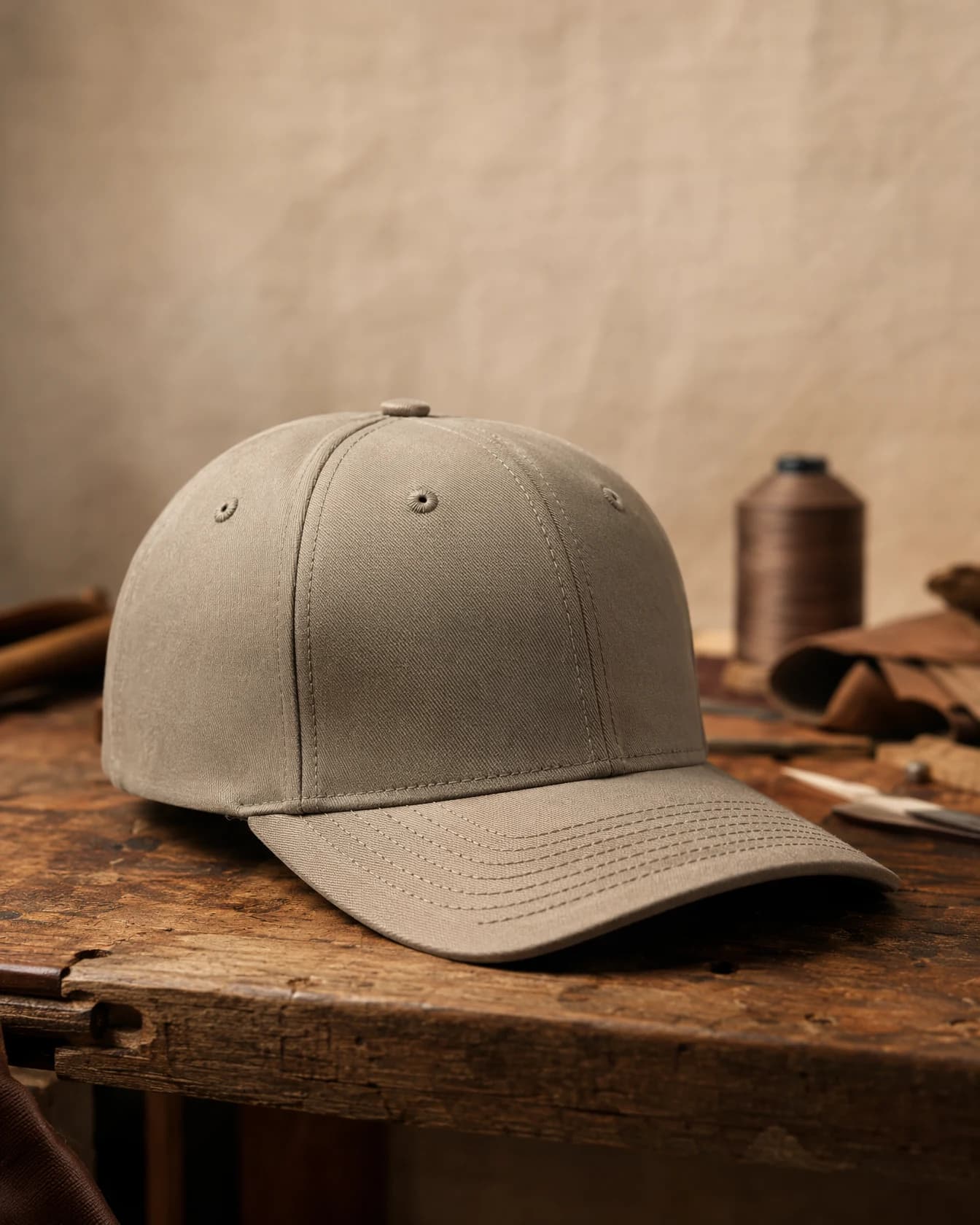
A cap is a stack of small decisions — construction, decoration and closure — and each one moves both the look and the price. That makes headwear one of the easiest categories to get almost right and one of the hardest to get exactly right, because a crown that sits two millimetres too tall or an embroidery that puckers is visible from across the room.
This guide walks through how caps and hats are actually built, which decoration methods suit which designs, what MOQs and prices look like, and the quality checks that separate a merch-table cap from one people wear by choice.
Construction: what the panel count really means
Almost every cap on the market is a variation on a few structural families, and the differences are functional, not just aesthetic.
- Six-panel — the classic baseball silhouette. Two front panels meet at a centre seam, which needs a decoration that tolerates a seam or sits below it.
- Five-panel — a single flat front panel, no centre seam. The default for camp caps and for large front prints or woven patches that need an uninterrupted surface.
- Dad hat — a six-panel with no buckram stiffening and a curved pre-formed visor. Soft, low-profile, usually in washed cotton twill.
- Trucker — foam or structured front with mesh back panels for breathability; snapback closure almost by definition.
- Bucket hat — cut-and-sew from fabric panels with a stitched brim; behaves more like a sewn garment than a cap and is sized rather than adjustable.
- Beanie — knitted, not sewn: gauge, yarn and whether it is cuffed or fisherman-length are the design decisions, and decoration is usually a woven label or small embroidery.
Structured or unstructured
Structure comes from buckram — a stiff interlining fused behind the front panels — plus how the crown seams are built. Structured caps hold a tall, formal front; unstructured caps collapse softly against the head. Neither is better; a 3D puff logo needs the flat, firm canvas of a structured front, while a minimal embroidered wordmark often looks more expensive on an unstructured dad hat.
Fabrics and trims
Cotton twill (usually 108x56 construction) is the standard body fabric; brushed cotton reads premium; washed or pigment-dyed twill gives the lived-in look; acrylic-wool blends dominate snapbacks; polyester and recycled polyester run cooler and hold colour for sports styles. The trims are where quality is felt: the sweatband (cotton or moisture-wicking), the taping over internal seams, the eyelets (embroidered or metal), and the closure.
| Closure | Adjustment | Typical style | Notes |
|---|---|---|---|
| Snapback | Plastic snap tab | Flat-visor street styles | Cheap, durable, very standard |
| Strapback | Fabric strap + metal slide or clip | Dad hats, premium casual | Brass hardware reads high-end |
| Velcro | Hook-and-loop strap | Sports, promotional | Fast to adjust, wears out first |
| Fitted | None — sized crown | Performance, classic baseball | Needs a size run; higher stock risk |
| Elastic / flexfit-style | Stretch band | Athletic | One or two sizes cover most heads |
Decoration: where cap budgets are won and lost
Embroidery is the default language of headwear, and it is priced by stitch count — a small left-chest-sized logo might run 5,000 stitches, a dense full-front design 25,000 or more. Flat embroidery handles fine detail; 3D puff embroidery raises bold shapes with a foam underlay but cannot render thin lines or small text. Woven patches sewn or heat-applied to a five-panel front give sharp detail at lower cost per unit on larger runs. Screen print and heat transfer work on flat fronts and buckets but read more promotional than premium.
“The most common headwear mistake is a logo designed on screen without a stitch check. Fine serifs and 1 mm strokes do not survive embroidery — redraw for thread before sampling, not after.”
MOQ, price and lead time
Headwear MOQs are friendlier than cut-and-sew apparel because bodies are often produced on standing lines: typically 100–300 pieces per style and colour for decorated stock-body programmes, and 500–1,000 for fully custom construction where fabric is bought for your order; our own headwear programmes start at 300–500 pieces per style. Indicative FOB prices run roughly $2.50–$5.50 for a decorated six-panel or dad hat at moderate volume, $1.80–$3.50 for truckers, and $1.50–$3.00 for standard-gauge beanies — with fabric choice, stitch count and hardware moving the number. Sampling takes one to two weeks; bulk production typically four to eight weeks depending on decoration load.
Quality checks that matter on headwear
- Crown symmetry — panels aligned, seams straight, no twist when viewed front-on.
- Embroidery density and trim — no gaps, no loose ends, backing fully covered.
- Visor bond — no bubbling or separation between visor board and fabric.
- Sweatband attachment — even, secure, no puckering; it takes the most wear.
- Colour consistency across panels — panels cut from different roll positions can shade.
- Closure function — snaps engage fully, sliders hold, velcro aligns.
Frequently asked questions
What is the MOQ for custom caps?
Across the trade, typically 100–300 pieces per style and colour when decorating standard bodies, and 500–1,000 pieces for fully custom construction where fabric and trims are sourced for your order; Belle Vouz's own headwear programmes start at 300–500 pieces per style. Headwear MOQs run friendlier than cut-and-sew apparel because cap bodies — six-panel, five-panel, dad hat, trucker — are often produced on standing lines rather than cut from scratch for each order, so a factory can decorate an existing body without committing to a full fabric purchase. Fully custom construction removes that shortcut: buckram, twill and trims all have to be bought specifically for your programme, which is why the MOQ jumps. If you're testing a design, start with a stock body and embroidery or a woven patch before committing to custom construction and its higher minimum.
How much does a custom cap cost to produce?
Roughly $2.50–$5.50 FOB for a decorated six-panel or dad hat at moderate volumes, with truckers running $1.80–$3.50 and standard-gauge beanies $1.50–$3.00 — those styles use less fabric and simpler construction, which is why they price lower than a fully structured six-panel. Within any style, stitch count is the biggest single lever: a small left-chest logo at around 5,000 stitches costs far less to run than a dense full-front design at 25,000 stitches or more, because embroidery machines are effectively priced by run time. Fabric quality, such as brushed cotton versus standard twill, hardware grade on the closure, and any wash or dye process add on top of that base. Get a stitch count estimate on your artwork before quoting, not after.
What is the difference between flat and 3D embroidery?
Flat embroidery stitches directly onto the fabric and handles finer detail, making it the right choice for wordmarks, fine linework or anything with small text. 3D puff embroidery stitches over a foam underlay to raise the design off the cap, giving bold, thick shapes real presence, but the foam can't hold thin lines or small text — they blur or collapse under the raised stitching. Both are priced by stitch count, so a dense design costs more to run regardless of technique. If your logo has fine serifs or strokes under about 1 mm, it needs redrawing for thread before it goes near a hoop — that kind of detail simply does not survive embroidery, flat or puff. Woven patches are the usual fallback for sharp fine detail at lower cost on larger runs.
Five-panel or six-panel — which should I choose?
Choose five-panel when your front design needs an uninterrupted surface — a large front print or a woven patch that can't tolerate a break in the fabric, since the five-panel has a single flat front panel and no centre seam. Choose six-panel for the classic baseball silhouette, where two front panels meet at a centre seam; that works fine for embroidery placed to sit below or beside the seam, but it constrains a design that needs to run edge to edge. The choice also affects the rest of the build: six-panel is the base for both structured caps and unstructured dad hats, while five-panel is the default for camp-style caps. If you're unsure, send the artwork and we'll tell you which panel count keeps it intact.
Are one-size caps really one size?
Adjustable closures cover roughly 55–60 cm head circumferences, which fits most adults, but 'one size' still depends on which closure you pick. Snapbacks and strapbacks give the widest adjustment range and are the standard choice for a genuine one-size product; velcro adjusts just as freely but wears out fastest with repeated use; elastic or flexfit-style stretch bands cover most heads with only one or two sizes needed. Fitted styles are the exception — they have no adjustment at all, a sized crown instead, and need a proper size run, usually four to six sizes, to fit a range of customers. That size run raises inventory risk considerably compared with a single adjustable SKU, which is why most private-label programmes default to an adjustable closure.
How long does cap production take?
One to two weeks for a decorated sample, then about four to eight weeks for bulk, depending on quantity and embroidery load — a dense full-front design at 25,000 stitches or more takes noticeably longer to run than a simple left-chest logo. Fully custom construction programmes, where buckram, twill and trims are sourced specifically for your order rather than pulled from a standing line, add fabric lead time on top of that window. Before bulk ships, expect checks on crown symmetry, embroidery density and trim coverage, visor bond, sweatband attachment, colour consistency across panels, and closure function — catching a flaw at this stage is far cheaper than a returns problem later. Build the QC step into your timeline rather than treating it as a formality at the end.
Headwear rewards precision because everything is on show. Send us your logo and a reference cap — we will come back with a stitch-checked artwork, a construction recommendation and a costed sample plan, usually the same business day.
Homaira Jashim
Director, Belle Vouz Ltd
Homaira Jashim is a director of Belle Vouz Ltd and a co-founder of Collective Studio Ltd, its group company in Narayanganj. She works with brands from first enquiry to repeat orders.
More about the teamFree tools for clothing brands
MOQ, pricing and AQL calculators, a GSM ⇄ oz converter, a fillable tech pack template and a manufacturing glossary — built by our group company, Collective Studio, free to use.