Cap and hat manufacturer in Bangladesh
Belle Vouz makes private-label 5-panel and 6-panel caps, beanies and bucket hats in Bangladesh in cotton twill, wool blend and technical fabric, from 300 to 500 pieces per style. We publish the cost breakdown rather than a price, because fabric, decoration and volume move it too far.
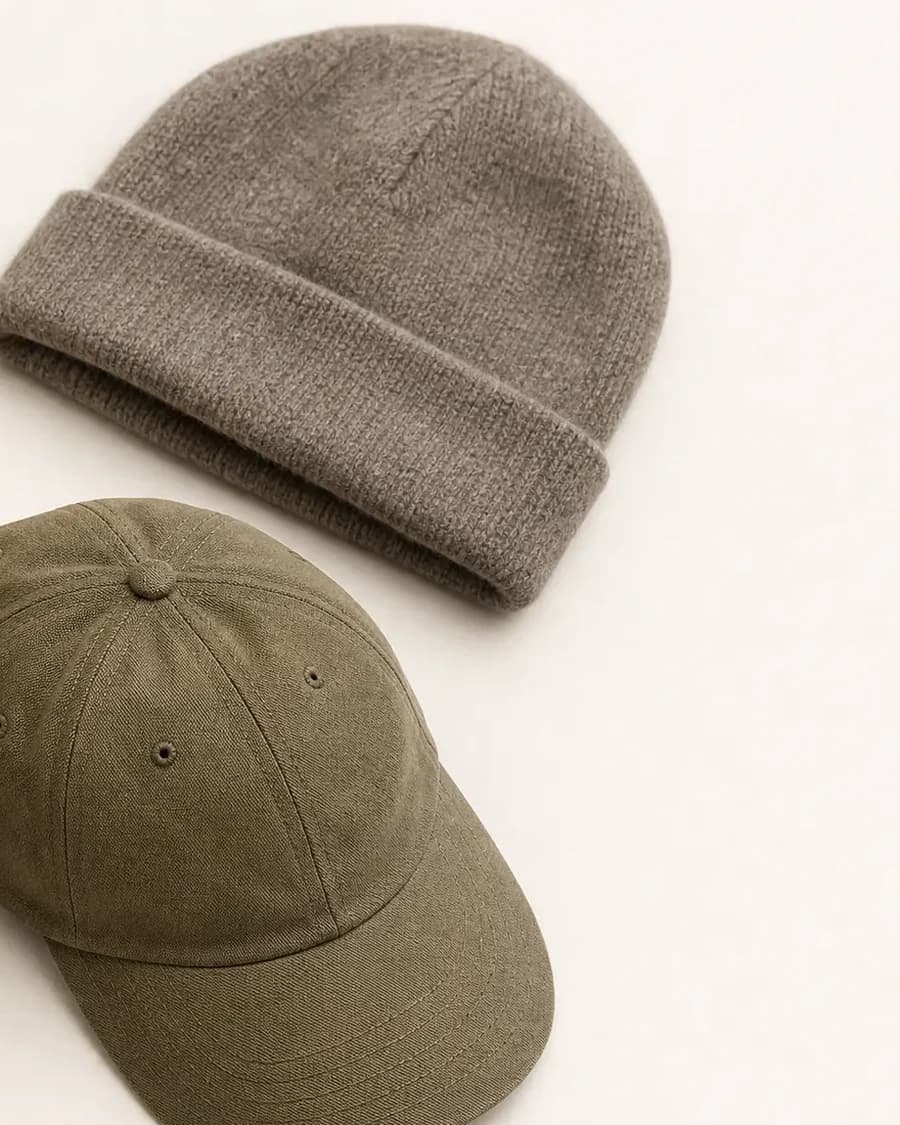
Overview
Structured 5- and 6-panel caps alongside beanies and bucket hats, where panel count and crown structure decide both fit and silhouette. 5-panel caps have a flatter, lower-profile crown with an asymmetric panel split; 6-panel caps have the more traditional rounded, structured crown most baseball caps use. Embroidery on curved panels needs its own tension settings distinct from flat garment embroidery, which is exactly why not every factory does headwear decoration well — a logo that looks clean on a flat digitised proof can pucker or distort once stitched onto a curved cap panel if the machine and operator aren't set up specifically for headwear. Closures — snapback, strapback, fitted or elastic — and fabric choice (cotton twill, wool blend, technical fabric) round out the spec, but panel construction and decoration precision are what separate a merch-table cap from one people actually wear by choice.
What's actually in the spec.
| Construction | Crown profile | Typical use |
|---|---|---|
| 5-panel | Flatter, lower profile, asymmetric split | Streetwear, casual branding |
| 6-panel | Traditional rounded, structured | Classic baseball caps, sport branding |
| Unstructured / dad-cap | Soft, no buckram front panel | Relaxed, vintage-leaning styles |
There's no honest single number to publish here.
Hats & Caps pricing varies too much by leather grade, hardware and volume for a general range to mean anything. Here's what actually makes up the FOB price, so you can read a quote line by line instead of taking a number on faith.
| Cost component | Share of FOB | What it covers |
|---|---|---|
| Fabric | 38–52% | Yarn, knitting or weaving, dyeing, finishing |
| Trims & accessories | 5–12% | Labels, zips, buttons, thread, elastic, packaging |
| CM (cut & make) | 15–25% | Cutting, sewing, finishing, factory overhead |
| Wash / print / embroidery | 0–15% | Optional decoration — adds up fast |
| Factory margin & compliance | 8–12% | Audits, certifications, testing |
300–500 pieces per style
8–12 weeks from approved tech pack to ex-factory
What buyers ask about hats & caps.
Why is embroidery on caps harder than on a flat garment?
Curved panels genuinely require their own tension settings, distinct from the flat-garment embroidery most factories run as their default process, and that difference is exactly why not every factory produces clean headwear embroidery even if their tee and hoodie embroidery is excellent. A logo that digitises and stitches perfectly on a flat proof can pucker, shift or distort once it's actually stitched onto a curved cap panel if the machine and operator aren't specifically calibrated for headwear — the panel's curve fights the needle's straight-line assumptions in a way flat fabric never does. This is worth asking about directly before committing artwork to production: request a stitch-checked sample specifically on the cap construction you're using, not just a flat mock-up, since that's the only way to catch a puckering or distortion problem before it shows up across a full production run.
What's the difference between 5-panel and 6-panel caps?
5-panel caps have a flatter, lower-profile crown built from an asymmetric panel split — typically a single larger front panel rather than the two-panel front most 6-panel caps use — which gives them a distinctly streetwear-leaning silhouette. 6-panel caps use the more traditional rounded, structured crown that most baseball caps are built on, with six roughly equal panels meeting at the top, and it's the construction most people picture by default when they think "baseball cap." The choice isn't purely aesthetic: the panel count and seam placement affect how embroidery sits across the crown, since a logo spanning a seam needs to be digitised and positioned differently on a 5-panel than a 6-panel construction. Specify which panel count you want at the design stage, since it changes both the finished silhouette and how the artwork needs to be prepared.
Ready to cost your cap and hat programme?
Send a reference and a target quantity — we'll come back with construction options, costing and lead-time, usually the same business day.