In short
A tech pack is the technical specification a factory costs and builds a garment from: technical flats, bill of materials, points of measure with tolerances (usually ±1 to ±1.5 cm on major measurements), grading rules, Pantone TCX colourways, construction details, and label and packaging specs. It must be complete before bulk fabric is cut.
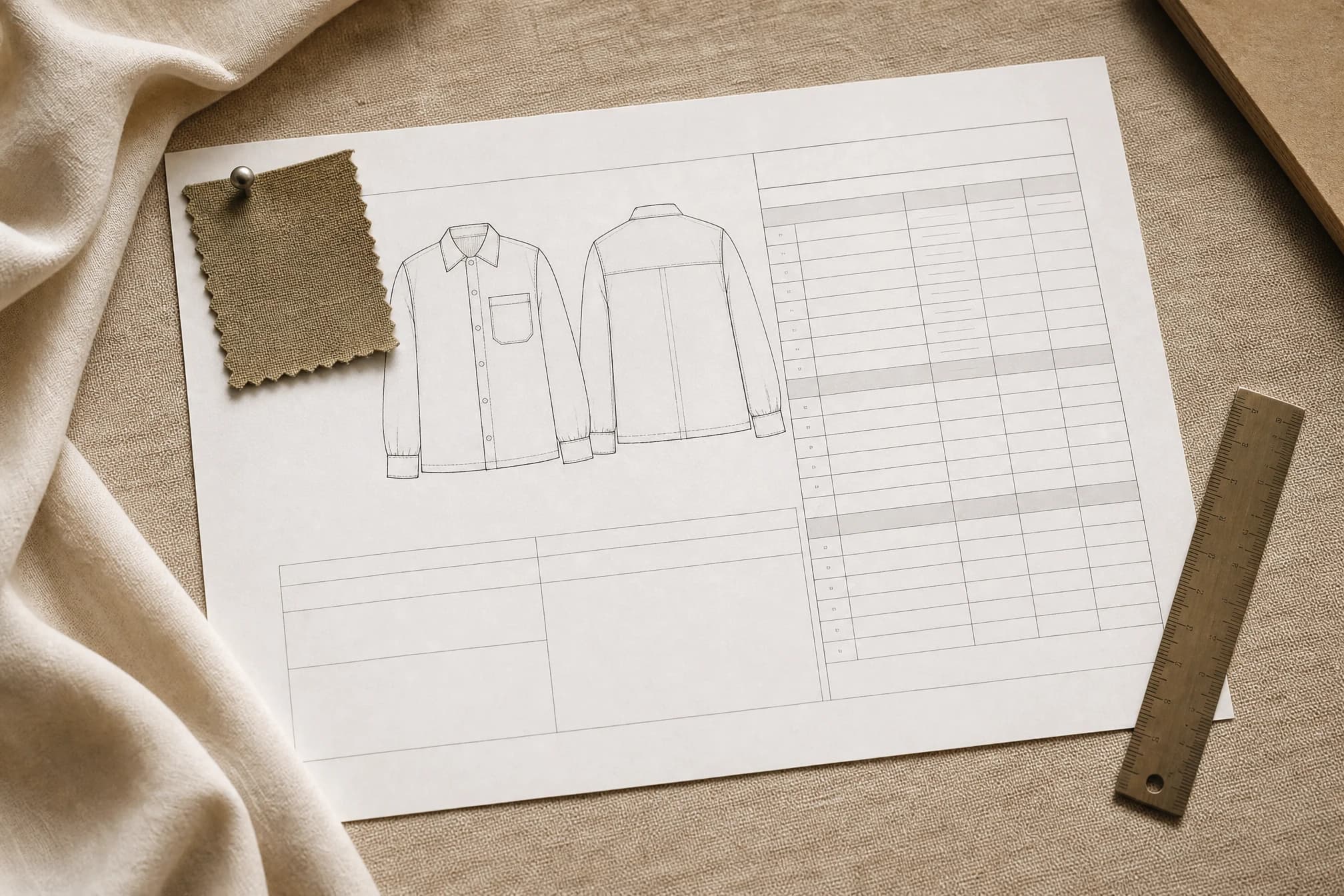
The single biggest cause of production disputes is a vague brief. A tech pack fixes that: it is the specification that tells a factory exactly what to make, so 'right' means the same thing to both sides. When a shipment argument reaches us from elsewhere, the root cause is almost always the same — something both parties assumed and neither wrote down.
This guide covers what belongs in a tech pack, section by section, the mistakes that cause the most expensive misunderstandings, and what to do if you do not have one yet — because you can absolutely start without one, as long as you know what the factory will need before bulk.
What a tech pack is — and is not
A tech pack captures measurements, materials, construction, trims, colours and tolerances in one document. It removes guesswork — and the arguments that follow guesswork. It is not a mood board, a lookbook or a single flat sketch; those communicate intent, while the tech pack communicates instructions. A good one lets a factory that has never spoken to you cost the garment accurately and build a first sample that is recognisably your product.
The sections, in the order factories read them
| Section | Contains | Costly if missing |
|---|---|---|
| Cover / style summary | Style name and number, season, size range, date, revision number | Version confusion — factory sews an old spec |
| Technical flats | Front/back/side line drawings with construction callouts | Design details invented by the pattern room |
| Bill of materials (BOM) | Every fabric, trim, thread, label and their placements, suppliers, references | Substituted trims; wrong interlinings |
| Points of measure (POM) | Numbered measurement spec for the base size, with tolerances | Fit disputes with no reference point |
| Grading rules | How each measurement changes per size | Sizes that fit differently from the sample |
| Colourways | Each colour version with Pantone TCX references per component | Screen-guess colour matching |
| Construction details | Stitch types, seam allowances, stitches-per-inch, hem depths | Cheapest-default construction |
| Labels & packaging | Brand, care, fibre-content labels; folding, polybag, carton specs | Non-compliant care labels; retail rejections |
Points of measure deserve special respect
The POM table is the contract inside the contract. Each measurement — chest at 2.5 cm below armhole, body length from HPS, sleeve length from shoulder point — gets a number and a tolerance, usually ±1 to ±1.5 cm on major points. When a fit sample arrives, you measure it against this table; when bulk arrives, the inspector does the same. Without it, 'the fit feels off' is an opinion. With it, it is a finding.
The mistakes that cost the most
- No tolerances — every measurement needs one; fabric is not sheet metal, and a spec without tolerances is unenforceable in both directions.
- Screen colours instead of standards — specify Pantone TCX (textile) references and approve physical lab dips. RGB values are not a dye recipe.
- Fabric named by feel — 'premium heavyweight cotton' is not a spec. Write composition, construction, finished GSM with tolerance, and reference an approved swatch.
- Missing revision control — every change gets a new revision number and date, and old versions are withdrawn. Factories sew what is in front of them.
- No care-label content — fibre composition is a legal requirement in the EU, UK and US, care instructions are mandatory in the US and Australia and expected by retailers elsewhere, and both get audited.
- Overloading the flat — cramming construction notes onto one drawing until nothing is readable. Use callouts and detail views.
“A tech pack is cheap insurance. The cost of writing one is a few days. The cost of not writing one is a production run that matches nobody's expectations — and no document to say whose fault that is.”
Starting without one
Plenty of good programmes start from a reference garment and a conversation. A capable manufacturer can reverse-engineer a sample you like, draft the pattern, and build the tech pack with you through the sampling process — proto to fit to pre-production — so that by bulk, the full spec exists. What matters is not who writes the document but that it exists before bulk fabric is cut. At Belle Vouz we build tech packs for buyers routinely; what we need to start is a reference sample or clear sketches, your target fit, and your size range.
Tools of the trade
Adobe Illustrator remains the standard for technical flats; purpose-built platforms like Techpacker and Backbone structure the BOM and POM data; a disciplined spreadsheet does the same job for small ranges. The tool matters far less than the completeness — factories receive beautiful, useless tech packs and ugly, complete ones every week, and they will take the ugly complete one every time.
Frequently asked questions
What is a tech pack?
A technical specification document for a garment: flats, bill of materials, points of measure with tolerances, grading, colourways, construction and labelling — everything a factory needs to make the product without guessing. It is not a mood board, a lookbook or a single flat sketch; those communicate intent, while a tech pack communicates instructions a factory can cost and build from. The point is to remove guesswork, because guesswork is where production disputes start — when a shipment argument reaches us from elsewhere, the root cause is almost always something both sides assumed and neither wrote down. A complete tech pack lets a factory that has never spoken to you before price the garment accurately and produce a first sample that is recognisably your product, rather than the pattern room's interpretation of it.
Do I need a tech pack to get a quote?
No — a reference garment or clear sketch with a fabric idea and quantities is enough for an indicative quote. You do need a full spec before bulk production, though, and a good manufacturer will help build it with you during sampling — reverse-engineering a reference sample, drafting the pattern, and developing the document through proto, fit and pre-production stages so the complete tech pack exists by the time bulk fabric is cut. What matters is not who writes it but that it's finished before that point. At Belle Vouz we build tech packs for buyers routinely; to start, we need a reference sample or clear sketches, your target fit, and your size range — the document develops alongside the sampling rounds rather than arriving finished on day one.
How much does a tech pack cost to have made?
Freelance technical designers typically charge $150–$500 per style depending on complexity, using tools like Adobe Illustrator for the flats and platforms such as Techpacker or Backbone to structure the bill of materials and points of measure. Manufacturers like us often build them as part of development for confirmed programmes, folding the cost into the sampling process rather than billing separately. Whichever route you take, completeness matters far more than production values — a beautiful tech pack with vague tolerances or missing revision control causes the same disputes as no tech pack at all, while an ugly but complete spreadsheet gets a factory to the right result. Weigh the $150–$500 against the alternative: a production run that matches nobody's expectations, with no document to establish whose fault that is.
What tolerances are normal?
±1 to ±1.5 cm on major body measurements, tighter on small ones like collar height. Every measurement in the points-of-measure table should carry a tolerance, because fabric is not sheet metal — some movement is unavoidable, and a spec without a stated tolerance is unenforceable in both directions, for you and for the factory. The tolerance is what turns a measurement into something checkable: when a fit sample arrives, you measure it against the POM table with its tolerance; when bulk arrives, the inspector does exactly the same. Without that number, 'the fit feels off' is just an opinion with nothing to test it against. With it, a measurement outside range is a finding both sides can act on, rather than a disagreement about perception.
How do I specify colours properly?
Pantone TCX textile references per component, confirmed by physical lab dips you approve before bulk dyeing. Never rely on screen colours — RGB values are not a dye recipe, and a colour that looks right on a monitor can shift substantially once it's mixed and dyed onto actual fabric. Skipping this step is one of the more expensive mistakes in a tech pack, because it leaves the factory to interpret a screen colour as best they can, which is effectively screen-guess colour matching at bulk scale. A physical lab dip, approved against a Pantone TCX reference before dyeing starts, gives both sides a physical object to check the bulk fabric against — the same discipline that points of measure bring to fit, applied to colour.
What is the difference between a tech pack and a spec sheet?
A spec sheet is usually just the measurement table — points of measure and tolerances, nothing else. A tech pack is the full document: spec sheet plus technical flats, bill of materials, construction details, colourways and labelling and packaging specs. The difference matters because each missing section causes a specific, predictable problem — flats without construction callouts leave design details to be invented by the pattern room, a bill of materials without supplier references invites substituted trims, and missing labelling specs risk non-compliant care labels and retail rejections. A spec sheet alone can get you an accurate fit; only the full tech pack gets you an accurate fit built in the right fabric, decorated the right way, and packed to the right standard.
Sources
Starting from a blank page? Our group company Collective Studio built a free, fillable tech pack template — sketch, materials, measurements, colours, labels and packaging — plus a checklist to catch anything missing before it reaches a factory. Send us whatever you have — a full tech pack, a sketch, or a garment you want to improve — and we will tell you what is missing, build the document with you, and quote against it properly.

Homaira Jashim
Director, Belle Vouz Ltd
Homaira Jashim is a director of Belle Vouz Ltd and a co-founder of Collective Studio Ltd, its group company in Narayanganj. She works with brands from first enquiry to repeat orders.
More about the teamFree tools for clothing brands
MOQ, pricing and AQL calculators, a GSM ⇄ oz converter, a fillable tech pack template and a manufacturing glossary — built by our group company, Collective Studio, free to use.