Activewear and sportswear manufacturer in Bangladesh
Belle Vouz makes private-label activewear in Bangladesh in polyester-spandex, nylon-spandex and recycled polyester, from 500 pieces per style and colour. We publish the cost breakdown rather than a price, because fabric, trims and volume move it too far.
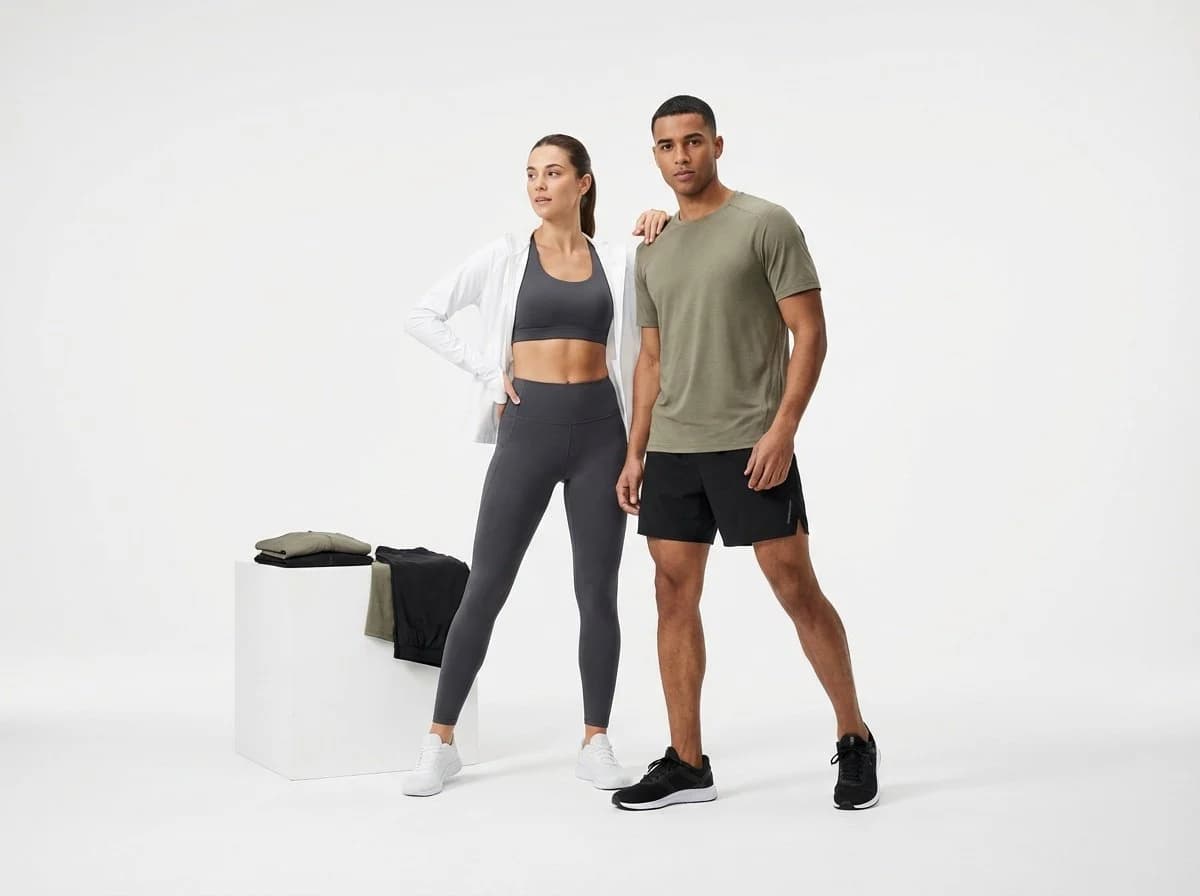
Overview
Polyester-spandex, nylon-spandex and recycled-content (rPET) fabrics engineered for performance, not just cut to a training-wear silhouette. Stretch is specified as 2-way (one direction, usually width) or 4-way (both length and width, with recovery) — 4-way is the standard for leggings and fitted training wear because it moves with the body's full range of motion rather than just giving in one axis. Moisture-wicking works through fibre cross-section shape or a hydrophobic-inside, hydrophilic-outside construction that actively pulls sweat to the fabric surface for faster evaporation; compression is engineered tension varied through the pattern itself, genuinely distinct from simply using a tighter stretch fabric. Construction choices matter as much as fabric: flatlock seams sit flat against the skin to reduce chafing, and mesh ventilation belongs at the body's actual heat-output zones — upper back, underarms — when it's genuinely performance-driven rather than decorative.
What's actually in the spec.
| Fabric | Composition | Stretch | Best for |
|---|---|---|---|
| Polyester-spandex jersey | 88–92% / 8–12% | 4-way | T-shirts, general training tops |
| Nylon-spandex | 78–85% / 15–22% | 4-way, higher recovery | Compression leggings |
| Recycled polyester (rPET) | Recycled PET + spandex | 4-way | Sustainability-positioned ranges |
There's no honest single number to publish here.
Activewear pricing varies too much by leather grade, hardware and volume for a general range to mean anything. Here's what actually makes up the FOB price, so you can read a quote line by line instead of taking a number on faith.
| Cost component | Share of FOB | What it covers |
|---|---|---|
| Fabric | 38–52% | Yarn, knitting or weaving, dyeing, finishing |
| Trims & accessories | 5–12% | Labels, zips, buttons, thread, elastic, packaging |
| CM (cut & make) | 15–25% | Cutting, sewing, finishing, factory overhead |
| Wash / print / embroidery | 0–15% | Optional decoration — adds up fast |
| Factory margin & compliance | 8–12% | Audits, certifications, testing |
500 pieces per style/colour
10–16 weeks from approved tech pack to ex-factory: sampling and approvals, fabric booking, then 45–75 days of bulk production
What buyers ask about activewear.
What is compression fabric, exactly?
Compression fabric is fabric and pattern engineered together to apply controlled, graduated pressure across specific areas of the body — and the key word is "engineered," because it's genuinely distinct from simply using a very tight stretch fabric and calling it compression. A tight 4-way stretch legging squeezes uniformly and can actually restrict movement without providing targeted support anywhere in particular. True compression construction varies the tension deliberately through the pattern itself — tighter at certain points, calibrated elsewhere — to support specific muscle groups or improve circulation during and after activity. If a brief calls for compression, that needs to be specified as its own construction requirement in the tech pack, not assumed to follow automatically from choosing a high-stretch fabric.
What's the difference between 2-way and 4-way stretch?
The difference is about how many directions the fabric actually moves and recovers in, and it matters far more for activewear than for almost any other garment category. 2-way stretch fabric stretches in one direction only, usually across the width, which is fine for a relaxed training top that doesn't need to move with the body through a full range of motion. 4-way stretch fabric stretches and recovers in both length and width simultaneously, tracking genuine body movement rather than just giving in one axis — which is exactly why it's the standard for leggings and fitted training wear, where the fabric needs to move with a squat or a stride and snap back to shape afterward rather than sagging. Specifying 4-way stretch when a product genuinely needs it, rather than defaulting to whatever a factory has in stock, is often the difference between activewear that performs and activewear that just looks like it should.
Is recycled polyester as durable as virgin polyester?
Performance-wise, largely comparable when it's properly manufactured — recycled polyester, or rPET, can deliver essentially the same stretch, durability and moisture-management properties as virgin polyester once it's spun and knitted correctly, so a sustainability-positioned activewear range doesn't have to sacrifice actual performance to make that claim. Where the real differences show up are cost, which typically runs somewhat higher than virgin polyester, and verification, which matters more than most brands initially expect. "Recycled content" is an easy claim to make and a genuinely easy one to fake with an unverified "eco" label, so it's worth asking specifically for recycled-content verification or a transaction certificate on any rPET fabric in a range rather than accepting the claim at face value. The fibre performance itself isn't the risk — the unverifiable sustainability claim sitting on top of it is.
Ready to cost your activewear programme?
Send a reference and a target quantity — we'll come back with construction options, costing and lead-time, usually the same business day.