In short
Most export clothing factories need around 500 pieces per style and colour, rising to 800 to 1,000 per style for denim and 1,000 to 3,000 pairs per design for socks. The real limit is the mill's dye lot of 300 to 500 kg per custom colour, so stock fabrics and standard colours are the quickest way to order less.
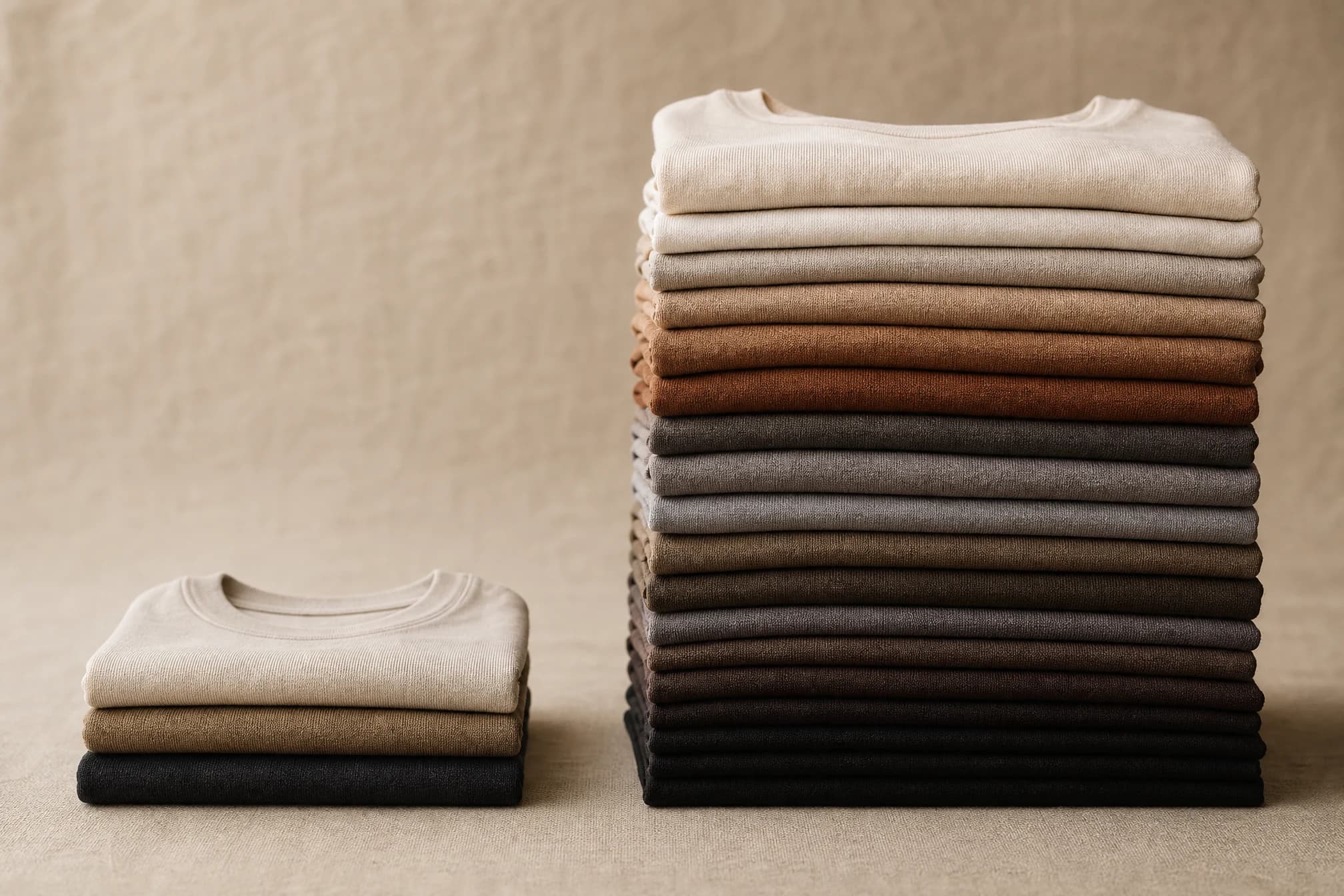
Minimum order quantity — MOQ — is the smallest run a factory will accept for a given style and colour. It is the first number that shapes a project, because it decides which manufacturers can even take the job, and it quietly sets your unit price. Understand it early and the rest of your sourcing gets easier.
Why MOQ exists
A garment is not just sewing. Before the first piece is cut, a factory buys fabric and trims by the roll and the carton, sets up cutting markers, and books machine and labour time. Those costs are the same whether you make 200 pieces or 2,000. Spread over a small run they make each piece expensive; spread over a larger run they nearly disappear. MOQ is how a factory protects the economics of setting up in the first place — it is not a test of how much you matter.
The three minimums hiding behind one word
Style MOQ
How many finished pieces per style the factory needs to run a line efficiently — commonly around 500 for cut-and-sew knits at export factories, spread across your size curve.
Colour MOQ
Within a style, each colour means its own fabric batch and a line changeover. A 1,000-piece order in two colours is two 500-piece problems; in five colours it may be refused, or priced like five small orders.
Fabric MOQ — the real boss
Mills dye yarn or fabric in batches, and a custom colour might require 300–500 kg of fabric whether you use it or not — roughly 1,000–2,000 t-shirts' worth. When a quote feels high for a small order, the fabric minimum is usually the reason. This is also the key to negotiating: stock fabrics and standard colours carry no dye-lot minimum, which is why low-MOQ programmes are built on curated fabric ranges rather than open-ended custom development.
| Product | Typical MOQ | Usual constraint |
|---|---|---|
| T-shirts, basics | 500–1,000 / colour | Fabric dye lot |
| Hoodies, sweats | 500 / colour | Fabric dye lot |
| Flat-knit sweaters | 300–500 / colour | Yarn minimums |
| Woven shirts, trousers | 500–800 / colour | Fabric + trim minimums |
| Denim | 800–1,000 / style | Fabric roll + wash batch |
| Socks | 1,000–3,000 pairs / design | Yarn + machine programming |
| Caps (stock bodies) | 100–300 / style | Decoration setup only |
| Leather jackets | 300–500 / style | Skilled labour, hides |
What going below MOQ really costs
Factories can often run below their stated MOQ — at a price. Expect a 15–30% unit premium just below the line, rising steeply further down, because the fixed setup is being spread over fewer pieces and leftover fabric from the dye lot is being billed to someone: you. Sometimes that premium is rational — a market test at 300 pieces with a 20% surcharge is cheaper than 1,000 pieces of unsold stock. Do that arithmetic explicitly rather than treating MOQ as a wall.
Six honest ways to work with a small budget
- Consolidate colours — one style in two colours beats three styles in one colour for meeting minimums and for merchandising focus.
- Use stock fabrics and standard colours — no dye-lot minimum, faster lead times, and the single biggest MOQ unlock available.
- Share fabric across styles — a tee and a relaxed long-sleeve cut from the same jersey pool one fabric minimum across two products.
- Start white-label-plus — an existing factory block with your fabric and branding needs far less setup than a new pattern.
- Phase the range — launch two styles at proper volume, add styles from revenue, rather than six styles below minimum.
- Use a low-MOQ specialist — purpose-built programmes exist for exactly this stage; our group company Collective Studio runs knitwear from 150 pieces per style and colour.
“MOQ is a negotiation about setup costs, not a judgement about your brand. Bring the factory a problem that fits its economics — shared fabrics, standard colours, honest volumes — and the minimum usually moves.”
Frequently asked questions
What is a typical MOQ for clothing manufacturing?
Around 500 pieces per style and colour for cut-and-sew garments at export factories, spread across your size curve — that figure holds fairly steady for basics, hoodies and woven shirts and trousers, though woven items can run to 800 and denim typically needs 800–1,000 per style because of fabric roll and wash-batch minimums. Flat-knit sweaters sit lower, at 300–500, constrained by yarn rather than fabric. Accessories are more forgiving: stock-body caps can start around 100 pieces because only the decoration needs setting up. Socks run higher, 1,000–3,000 pairs per design, since yarn purchasing and machine programming don't scale down easily. Specialist low-MOQ programmes, built around curated stock fabrics rather than custom development, can start around 100 pieces per style even for cut-and-sew knitwear.
Why do factories have minimum order quantities?
Before the first piece is cut, a factory buys fabric and trims by the roll and carton, sets up cutting markers, and books machine and labour time — costs that are identical whether the run is 200 pieces or 2,000. Spread over a small order those fixed costs make each piece expensive; spread over a larger one they nearly disappear, which is why factories set a floor. The biggest driver is usually the mill, not the sewing line: dye lots are batch-produced, and a custom colour can require 300–500 kg of fabric regardless of how much of it you actually use — roughly 1,000–2,000 t-shirts' worth. MOQ is simply the volume at which those fixed setup and dye-lot costs stop dominating the price per unit, rather than a judgement on the size of your order or your brand.
Can I negotiate MOQ down?
Often, but it works by reducing the factory's setup burden rather than by asking for a discount. Stock fabrics and standard colours carry no dye-lot minimum, which is the single biggest unlock, since the mill isn't running a custom batch for you. Consolidating colours into fewer, more focused options and sharing one fabric across multiple styles both spread the same fixed setup over more pieces. Starting from an existing factory block — building on a proven pattern rather than developing a new one — cuts setup further still. Where none of that closes the gap, factories will often run below their stated minimum for a premium of roughly 15–30% on the unit price, rising steeply the further below the line you go, since leftover fabric from the dye lot gets billed to you. Asking for a straight discount without offering any of this rarely succeeds.
What is the difference between style MOQ and fabric MOQ?
Style MOQ is the factory's efficient run length for a given design — commonly around 500 pieces for cut-and-sew knits at export factories, spread across your size curve. Fabric MOQ sits underneath that: it's the mill's minimum dye lot, often 300–500 kg for a custom colour, equivalent to roughly 1,000–2,000 t-shirts' worth of cloth. Because each colour within a style needs its own fabric batch and its own line changeover, a 1,000-piece order split across two colours is really two 500-piece problems, and the same order split across five colours may be refused outright, or priced as five separate small orders. In practice the fabric minimum is usually the binding constraint, not the style minimum — which is why stock fabrics and standard colours, which carry no dye-lot minimum at all, are the fastest way to work below a factory's usual floor.
Is it worth paying a surcharge to order below MOQ?
Sometimes — it depends on what you're comparing the surcharge against. Going below a factory's stated minimum typically costs a 15–30% unit premium, rising steeply the further below the line you go, because the same fixed setup costs and any leftover dye-lot fabric are being spread over fewer pieces. Judged against the unit price of a full-size run, that premium looks expensive. Judged against the alternative — ordering to the full minimum and sitting on unsold stock — it usually isn't: a 20% premium on a 300-piece market test is far cheaper than carrying 700 pieces nobody bought. The right comparison is the surcharge against your actual inventory risk for that style, not against the big-run price you'd get if you were confident in the volume. Do that arithmetic explicitly before treating a factory's MOQ as a fixed wall you either meet or walk away from.
Where can I manufacture with only 150 pieces?
Through low-MOQ specialists that are built around curated, stock fabric ranges rather than open-ended custom development — the same principle that unlocks any low-volume order, since standard colours carry no dye-lot minimum. Belle Vouz's own standard MOQ is 500 pieces per style and colour, in line with typical export-factory minimums for cut-and-sew garments; below that, our group company Collective Studio picks up production from 150 pieces per style and colour, with worldwide DDP delivery so there's no separate freight negotiation on a small order. If you're not sure whether your target quantity clears a given minimum, Collective Studio also publishes a free MOQ calculator that splits a target order across styles and colours — a quick way to sense-check a run before contacting any supplier.
Sources
Belle Vouz's standard MOQ is 500 pieces per style and colour; below that, Collective Studio picks up from 150. Want to run your own numbers first? Collective Studio, our group company, built a free MOQ calculator that splits a target order across styles and colours — a quick way to sense-check a run before you email anyone. Tell us your quantities honestly and we will route you to the right programme — including telling you when you are not ready for us yet.
Homaira Jashim
Director, Belle Vouz Ltd
Homaira Jashim is a director of Belle Vouz Ltd and a co-founder of Collective Studio Ltd, its group company in Narayanganj. She works with brands from first enquiry to repeat orders.
More about the teamFree tools for clothing brands
MOQ, pricing and AQL calculators, a GSM ⇄ oz converter, a fillable tech pack template and a manufacturing glossary — built by our group company, Collective Studio, free to use.